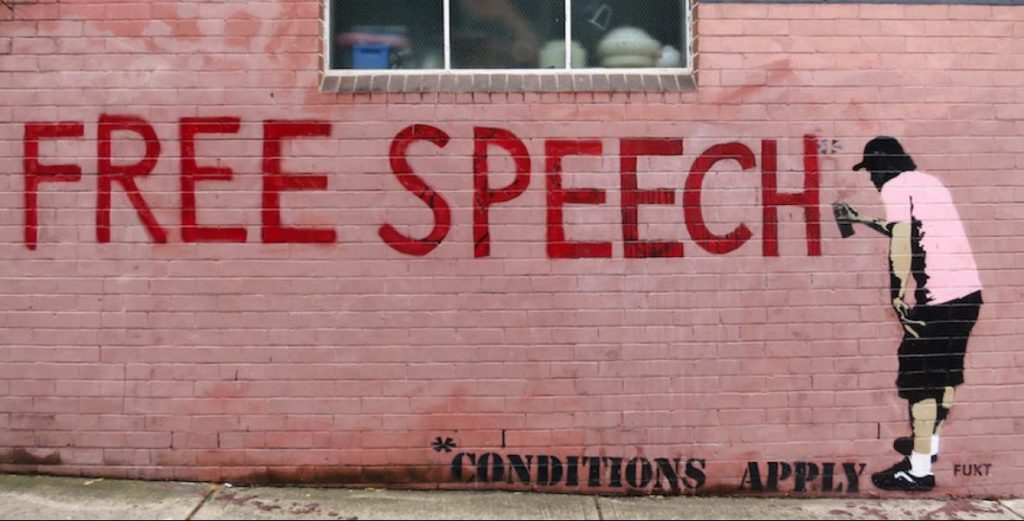
KINGSTON, ONTARIO: Today, Queen’s University again seized the “free speech wall” set up on campus by Queen’s Students for Liberty. Campus security confiscated the entire wall (paper, as well as the wood structure) on orders from Queen’s Provost and Vice-Principal (Academic) Dr. Alan Harrison, the Queen’s Alma Mater Society (AMS) and the Society of Graduate & Professional Students. Queen’s University further cancelled the remainder of the space booking for the hosting student group, Queen’s Students for Liberty.
Queen’s Students for Liberty first erected the wall on April 2. With the space booking approved, the wall was scheduled to stand from Tuesday April 2 through to 5:00 p.m. on Friday, April 5. The Queen’s Free Speech Wall is part of a campaign to raise awareness about free expression rights in Canada and is co-sponsored by the Justice Centre for Constitutional Freedoms.
In an e-mail sent to the Queen’s SFL at 4:06 p.m. (EST) today, Dr. Harrison told the club that the content of their display was “non-compliant” with Queen’s University Code of Conduct, the Queen’s Harassment/Discrimination Policy and Procedure, Residence procedures and the Student Code of Conduct.
This is the second time in less than 48 hours that the Queen’s free speech wall has been seized by University administrators, both times without any explanation of which particular comment or comments were deemed to have violated university policy.
“In the absence of a specific explanation as to which comment violated which university policy, the actions of Queen’s University in shutting down campus speech and confiscating students’ property are illegal,” stated lawyer and Justice Centre president John Carpay.
This conduct comes from the same university which in 2008 hired “student facilitators” to intervene anywhere on campus if they overheard “homophobic,” sexist, racist, or any “discriminatory” language. Queen’s University claimed that “they were tasked with spotting ‘spontaneous teaching moments’ concerning issues of race, religion, gender, sexual orientation, ability and social class, and to respond – either actively by posing questions to spur discussion, or more passively through activities like poster campaigns or movies.”