
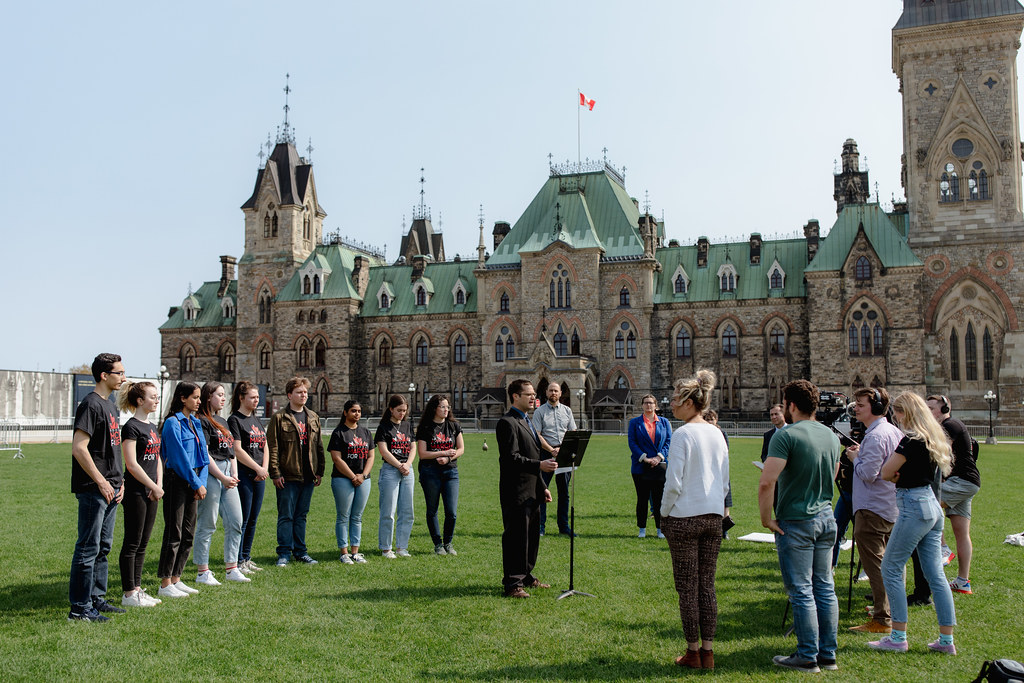
In May 2023, Campaign Life Coalition (CLC), a Canadian non-profit dedicated to advocating against abortion and euthanasia, organized a press conference on Parliament Hill ahead of its annual National March for Life. The event was scheduled for May 10, the day before the rally. Media were invited, and CLC planned to display signs depicting victims of abortion at various stages of development.
Before the press conference began, a Parliamentary Protective Service (PPS) officer inspected the group’s signs. After reviewing them, the officer prohibited CLC from displaying the images, citing that they were too graphic to be shown on Parliament Hill.
This decision was later confirmed in writing. In an email, PPS pointed to a policy document titled General Rules on the Use of Parliament Hill, which bans signs deemed “obscene, offensive, or that promote hatred.” A newer version of the policy explicitly prohibits “signs or banners that display explicit graphic violence or blood.”
Constitutional challenge launched
On June 30, 2023, a Notice of Application was filed in Federal Court on behalf of CLC and a woman who intended to hold one of the signs. The application challenges the constitutionality of the PPS’s actions and the policy that enabled them, alleging violations of the Charter–protected right to freedom of expression.
The Applicants are asking the Court to declare that both versions of the General Rules and the PPS decision to prevent the use of the signs infringed on their Charter rights.
“There is a certain irony to the fact that our government is currently spending hundreds of millions of dollars, domestically and abroad, promoting and facilitating a procedure it feels must be censored from the public eye,” says Josie Luetke, a spokesperson for Campaign Life. “We don’t like seeing the images of abortion either, and we hope Canadians do a lot of soul-searching as to why presenting its victims brings them such discomfort.”
“Parliament Hill is historically a public square where people of various viewpoints come to convey a message to the government and other Canadians,” adds Hatim Kheir, a constitutional lawyer funded by the Justice Centre. “Subjecting political expression on Parliament Hill to literal police censorship based on subjective criteria strikes at the core of Canadians’ democratic right to freedom of expression.”’
Hearing scheduled for March 5
The Ontario Superior Court of Justice will hear oral arguments on Thursday, March 5, 2026, in a case brought by Campaign Life Coalition (CLC) challenging a decision by the Parliamentary Protective Service (PPS) to prohibit the display of certain protest signs on Parliament Hill.
The case stems from a May 2023 press conference organized by CLC ahead of its annual National March for Life. Before the event began, a PPS officer inspected the group’s signs and prohibited CLC from displaying images of fetal remains deemed too graphic to be shown on Parliament Hill, citing rules banning images considered “obscene, offensive, or that promote hatred.” A later version of the rules expressly prohibited signs or banners displaying “explicit graphic violence or blood.”
CLC argues that the rule effectively gives authorities broad discretion to prohibit images they regard as objectionable, raising significant concerns about freedom of expression on Parliament Hill. “Using graphic images to expose injustice has long been a catalyst for social change,” says Matthew Wojciechowski, spokesperson for the CLC.
“Though difficult to look at, images of abortion expose a truth that words cannot. Censoring them on Parliament Hill—the heart of our democracy—reveals a deep hypocrisy and an alarming erosion of freedom of expression,” he added.
Constitutional lawyer Hatim Kheir said, “We look forward to this matter being heard. We hope that the court will agree that the Rules for the Use of Parliament Hill unjustifiably limit the freedom of expression of demonstrators.”
“If there is any place in our country that should be maximally available for people to proclaim a political message, it is Parliament Hill,” he added.