
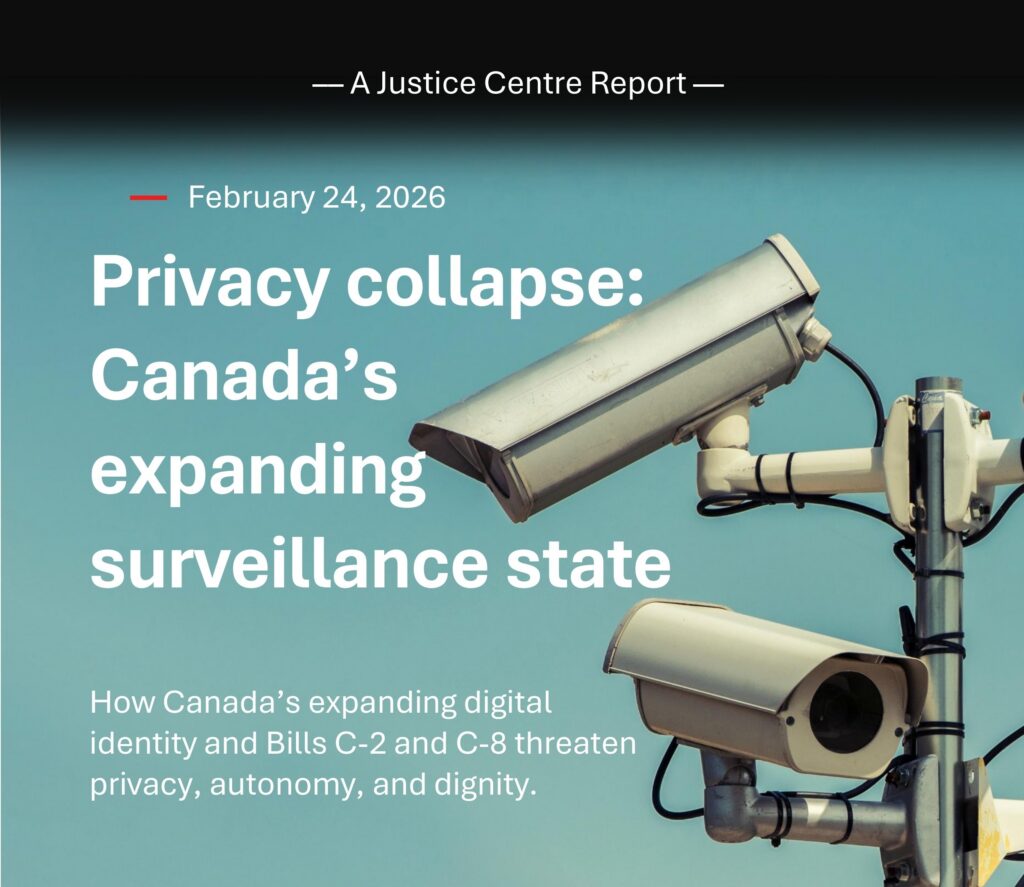
CALGARY, AB: The Justice Centre for Constitutional Freedoms announces the release of a new report titled Privacy collapse: Canada’s expanding surveillance state. The report, authored by veteran journalist and public policy analyst Nigel Hannaford, warns that Canada is undergoing a structural shift toward expanded government surveillance that threatens Canadians’ privacy, autonomy, and dignity.
The report explains how recent legislative proposals build upon existing surveillance infrastructure and the centralisation of digital identity to create the capacity for comprehensive surveillance. Bill C-2 (the Strong Borders Act) and Bill C-8 (An Act respecting cyber security) would significantly expand the government’s ability to access personal information, often without judicial oversight. These expanded powers arise in the shadow of the federal government’s unprecedented invocation of the Emergencies Act in 2022, which saw Canadians’ bank accounts frozen without warrants and their financial information shared with authorities.
Key findings from the report include:
- Warrantless access to private data: Bills C-2 and C-8 would allow government agencies to demand subscriber information, metadata, and private communications, including text messages and emails, from service providers without warrants. These powers could apply broadly to telecommunications companies, financial institutions, and other service providers, in some cases without notifying affected Canadians.
- Secret government orders and forced digital disconnection: Bill C-8 would empower federal officials to issue secret, binding ministerial orders to telecommunications providers and critical infrastructure operators. These orders could compel companies to remove products, restrict services, access private systems, weaken encryption protections, or disconnect individuals from digital networks, all without transparency, judicial oversight, or clear safeguards against abuse.
- Expansion of financial and identity surveillance: Expanded data-sharing powers under Bills C-2 and C-8, combined with financial surveillance tools and cash transaction limits, could enable persistent tracking of Canadians’ financial activities.
- Creation of an integrated “surveillance web”: The integration of financial monitoring, interoperable digital identity systems, expanded data-sharing powers, and mandatory data access requirements could create a centralized system linking identity, finances, communications, and online activity.
The report calls on governments to strengthen privacy protections, ensure meaningful judicial oversight of surveillance powers, and preserve Canadians’ ability to communicate, transact, and live their lives free from unjustified monitoring.
Report author Nigel Hannaford said, “Privacy is not secrecy. It is the foundation of personal autonomy, dignity, and freedom. Expanding warrantless surveillance powers risks permanently altering the relationship between Canadians and the state.”
He added, “Surveillance infrastructure, once built, rarely disappears. Canadians must carefully consider whether policies introduced in the name of safety may ultimately weaken the freedoms they are meant to protect.”
Canadians are also encouraged to sign the national petition calling on the government to scrap Bill C-2.