
TORONTO, ON: The Justice Centre for Constitutional Freedoms announces that a challenge brought by Ontario resident George Katerberg over government censorship of a political billboard along Highway 17 near Thessalon now awaits a hearing date in the Ontario Divisional Court, after the Ontario government filed its legal response claiming that the Charter’s protection for freedom of expression does not apply to political messages displayed on certain highways.
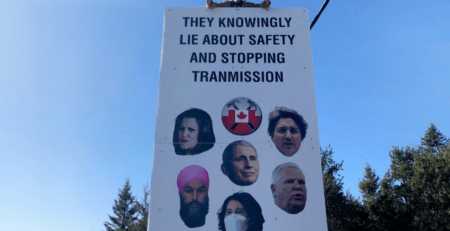
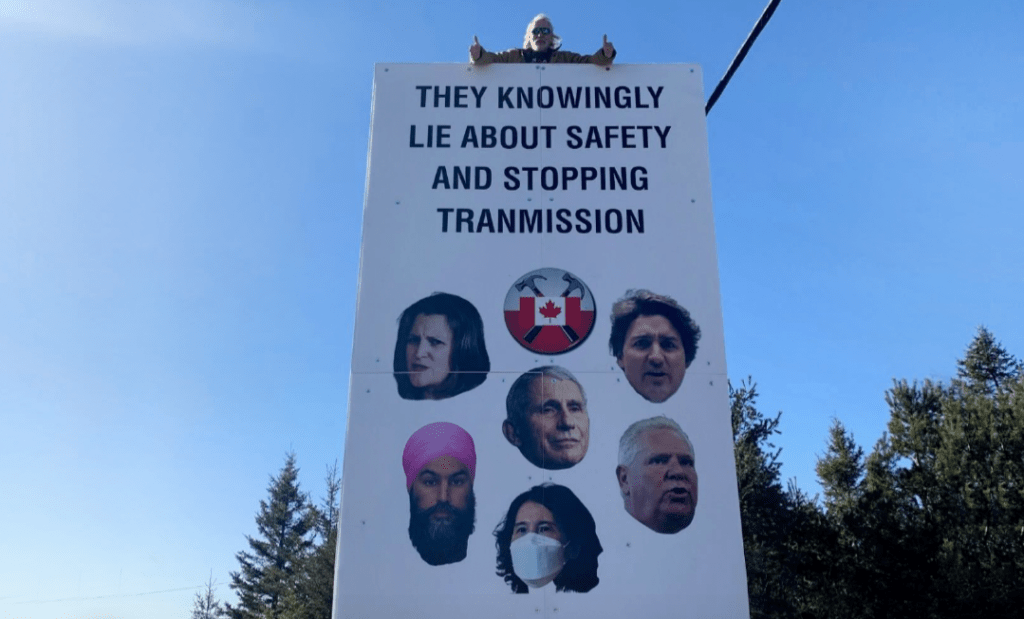
The case stems from a billboard that Mr. Katerberg rented on privately owned property, displaying a message that criticized key government and public health officials for statements made during the Covid pandemic. The billboard message included the statement, “They knowingly lie about safety and stopping transmission. Canadians demand accountability,” along with images including former Chief Public Health Officer of Canada Dr. Theresa Tam, former Prime Minister Justin Trudeau, and former Director of the National Institute of Allergy and Infectious Diseases Dr. Anthony Fauci.
After the sign was installed in May 2024, Ontario officials ordered it removed, initially claiming the message might promote hatred. The Ministry later acknowledged that the billboard did not promote hatred but refused permission again after quietly changing its highway signage policy in 2025.
The new policy restricts billboard messages on designated highways, allowing only advertisements that promote goods, services, or local events tied to businesses, municipalities, charities, not-for-profit organizations, or Indigenous communities.
Political and social messages are effectively prohibited under the policy.
Interestingly, the Crown’s position is that it decides where the Charter applies and where it does not, stating in part: “The Crown does not breach the Charter s. 2(b) rights of citizens by choosing not to allow its own property to be used to support political and social causes.”
Lawyers funded by the Justice Centre argue that the policy violates the Charter’s guarantee of freedom of expression.
Constitutional lawyer Chris Fleury said the case raises broader concerns about government censorship.
“The government cannot declare that political messages are off limits while simultaneously allowing commercial advertising. That approach undermines the core purposes of the Charter,” he said.
“Political expression is central to the freedom of expression in Canada and, as the Supreme Court of Canada has recognized, is instrumental to democratic governance.”
Court filings on behalf of Mr. Katerberg argue that billboards have historically been used to communicate a wide range of messages, including political viewpoints, and that restricting them to commercial content effectively bans political expression in those locations.