
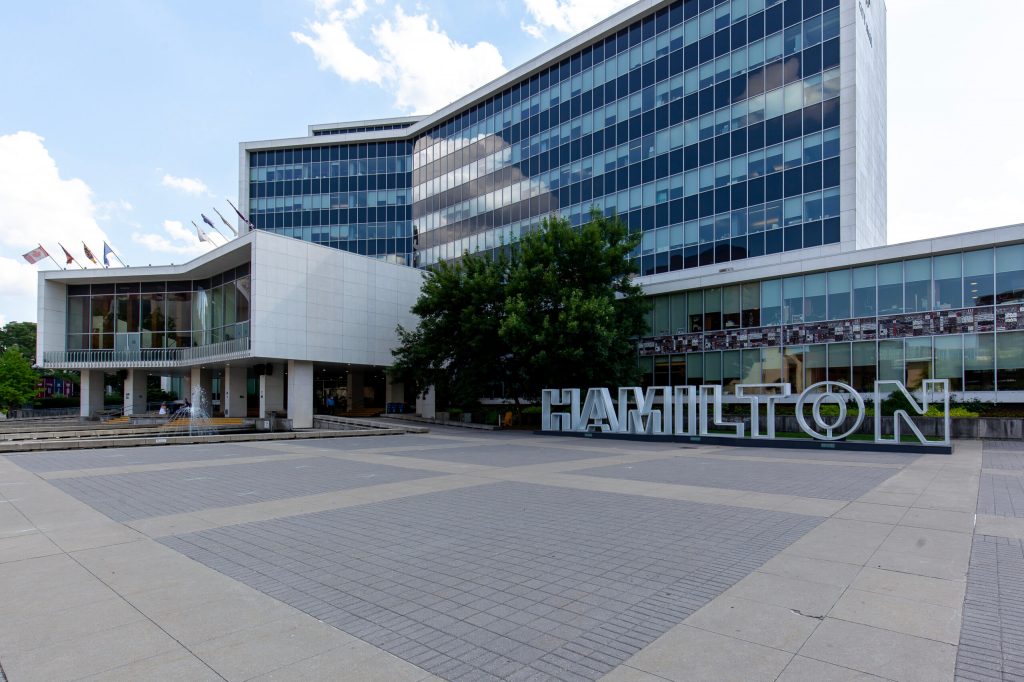
Dominion Society planned political conference in Hamilton
The Dominion Society of Canada planned to hold its DomCon conference in Hamilton, Ontario, on August 29, 2026.
The Society describes itself as a non-partisan advocacy group promoting Canadian identity, heritage, nationalism, immigration reform, and “remigration.”
Daniel Tyrie, founder and chairman of the Dominion Society, was involved in organizing the conference.
In the days leading up to the event, Hamilton Mayor Andrea Horwath and Hamilton Police Service took a series of steps aimed at preventing the conference from taking place in the city.
Hamilton Mayor refused City venues and contacted private businesses
Mayor Horwath stated that the City of Hamilton would not rent any City-owned venues to the Dominion Society.
She went further by writing to local businesses in an effort to influence them not to provide a venue for the conference.
This was not the first time Mayor Horwath had used her office to restrict a message she opposed. In August 2025, she directed that a billboard reading “Stop medical transitions for minors” be removed from City-leased property after describing its message as “transphobic.” The group responsible for the billboard challenged the decision as a violation of freedom of expression.
Hamilton Police said DomCon was “not welcome”
Efforts to prevent DomCon from finding a venue also involved Hamilton Police Service.
Darren Murphy, Acting Inspector in the Chief’s Office, stated that “Dom Con is not welcome in Hamilton.”
Hamilton Police then issued a news release encouraging venues not to rent to the Dominion Society and asking members of the public to report possible venue bookings to police.
No crime was identified in connection with the conference.
Instead, Hamilton Police described DomCon’s messaging as “divisive and exclusionary” and stated that it could “negatively impact the sense of safety and belonging” in Hamilton.
The police request for information about possible venues drew criticism and ridicule online, with some Canadians describing the phone number as a “snitch line” and questioning why police were asking the public to report the location of a political gathering.
Mr. Tyrie said, “I never expected that organizing a peaceful political conference in Canada would mean having to contend with the mayor and police actively trying to stop us from finding a place to meet.”
He added, “We have spent months organizing this conference, only to watch public officials pressure venues and encourage people to report us to police. It has made an already difficult job enormously harder, simply because they disagree with what we have to say.”
Lawyers warned that government actions violated Charter freedoms
On August 28, 2026, lawyers funded by the Justice Centre sent a warning letter to Mayor Horwath and Hamilton Police.
The letter stated that the collective actions of the City and Hamilton Police amounted to the use of government power to prevent or hinder an expressive assembly in Hamilton. It argued that these actions violated freedom of expression and freedom of peaceful assembly under the Canadian Charter of Rights and Freedoms.
Constitutional lawyer Hatim Kheir said, “The City of Hamilton and Hamilton Police are using both direct action and their influence to exclude a viewpoint they disagree with from the entire city. This is unconstitutional and fundamentally at odds with the way a free and democratic society operates.”
Recent Quebec decision warned against government viewpoint discrimination
The warning letter pointed Hamilton officials to a recent Quebec Superior Court decision involving similar government interference with an event.
In Harvest Ministries International v. Proulx, the Court found that Quebec’s former tourism minister violated freedom of expression when she ordered the cancellation of a government venue contract with a Christian organization because she disagreed with views associated with the event.
The Court concluded that preventing a message from reaching the public because it displeased a government official or caused unease within government was not a valid justification for restricting freedom of expression. The Court ordered more than $60,000 in compensatory and punitive damages.
Dominion Society prepared legal action against Hamilton Police Service Board
Lawyers funded by the Justice Centre began preparing a civil action on behalf of the Dominion Society against the Hamilton Police Service Board over police efforts to prevent DomCon from taking place in Hamilton.
An October 2, 2026, notice of pending legal proceedings outlined further details of the police involvement. It stated that police told organizers to cancel DomCon and move the event outside Hamilton, actively contacted potential venues, and cautioned them against hosting the conference.
The notice explains these efforts forced the Society to look outside Hamilton for a venue.
The proposed action seeks damages under section 24(1) of the Canadian Charter of Rights and Freedoms for interference with the Society’s freedom of expression. The lawyers argued that preventing expression because police considered it “divisive and exclusionary” was not a valid policing objective. They further argued that the police actions were not authorized by law and could not be justified under section 1 of the Charter.
The notice requested that the Board and Hamilton Police preserve all potentially relevant evidence, including communications with conference organizers and venues, electronic messages, internal records, and recordings.
The amount of damages remained under investigation. The anticipated proceeding could also name individual officers and other parties identified through the evidence.