
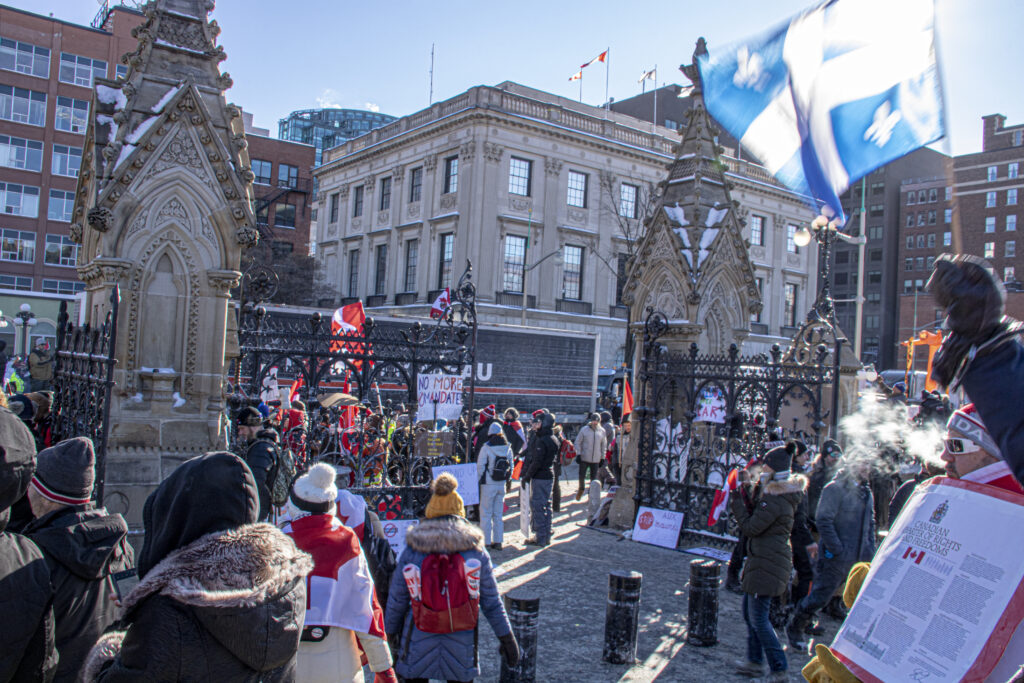
Thousands gather in Ottawa to protest Covid vaccine mandates
In January and February 2022, thousands of Canadians travelled to Ottawa as part of the Freedom Convoy to protest federal Covid vaccine mandates.
Truckers and other protestors gathered in downtown Ottawa and around Parliament Hill. Some Ottawa residents objected to the protest and complained about noise, horn honking, idling trucks and other disruptions.
In February 2022, Ottawa residents Zexi Li and Geoffrey Delaney, Happy Goat Coffee Company, and 7983794 Canada Inc., which operates the Ottawa restaurant Union: Local 613, launched a proposed $290-million class-action lawsuit against Chris Barber, Tamara Lich, and other Freedom Convoy participants.
The lawsuit seeks damages over alleged harms caused by the protest. It targets individual protestors as well as all truckers who participated in the protest, as well as people who donated to the Freedom Convoy after February 4, 2022, arguing that those donors “knew or ought to have known” that their money would be used to cause the alleged harms.
This means that people who financially supported the protest could potentially face liability alongside those who actually participated in it.
Lawyers challenge attempt to hold protestors and donors collectively responsible
On December 20, 2022, constitutional lawyer James Manson brought a motion seeking to strike all or part of the lawsuit.
He argued that the lawsuit improperly grouped together large numbers of protestors and treated them as though they had all acted as a single unit. Rather than identifying which individual allegedly harmed which plaintiff, the lawsuit sought to impose responsibility across a broad group of people who participated in different ways.
The same concern applied to donors. Determining whether someone who donated money intended to support unlawful conduct would require examining that individual donor’s circumstances and intentions.
“It is critical in every lawsuit for a plaintiff to properly plead his or her claim, so that defendants, and the court, understand the allegations and the issues raised,” said Manson on January 24, 2023. “Our view is that this lawsuit, as currently pleaded, fails to achieve that important goal. Accordingly, the court should exercise its supervisory powers and strike out the claim as currently drafted. We are confident that our arguments today will give the judge a lot to think about.”
The motion to strike was ultimately dismissed, and the lawsuit was permitted to continue.
Defendants argue the lawsuit threatens political expression
In June 2023, lawyers brought a separate procedural challenge, known as an “anti-SLAPP motion,” on behalf of Chris Barber, Tamara Lich, and other defendants, asking the court to dismiss the lawsuit.
Anti-SLAPP laws are intended to protect people from lawsuits that improperly silence or punish expression on matters of public interest.
Lawyers argued that travelling to Ottawa, participating in the Freedom Convoy and donating to the protest were different ways in which Canadians expressed their opposition to the federal government’s response to Covid.
They argued that this political expression lay at the heart of freedom of expression protected by section 2(b) of the Canadian Charter of Rights and Freedoms and that its importance outweighed the plaintiffs’ allegations of nuisance.
At a December 14, 2023, hearing before the Ontario Superior Court of Justice, Mr. Manson stated, “Zexi Li’s lawsuit engages the very purpose that ‘anti-SLAPP’ legislation was designed to address: an attempt to silence peaceful expression, and the right of defendants to participate in public debate.”
Courts allow the $290-million lawsuit to continue
On February 5, 2024, Justice Calum MacLeod dismissed the anti-SLAPP motion, allowing the lawsuit to continue.
The defendants appealed that decision to the Court of Appeal for Ontario. They argued that the lower court had not properly balanced the alleged harm against the public importance of protecting expression on matters of public interest.
On March 6, 2025, the Court of Appeal dismissed the appeal.
John Carpay, President of the Justice Centre, stated, “The fundamental Charter freedoms of expression, association and peaceful assembly must be vigorously protected and defended, whether they are attacked directly by government or indirectly through a misguided civil action.”
The lawsuit therefore continued toward the next major question: whether the plaintiffs would be permitted to pursue their claims against protestors and donors collectively as a group of three classes.
Undisclosed agreement raises new fairness concerns
The case took another turn in January 2026 after defence lawyers learned about an agreement between the plaintiffs and one of the defendants that had not been disclosed to the other defendants for nearly 19 months.
The agreement had been signed in April 2024 between the plaintiffs and defendant Chad Eros. It required Mr. Eros to provide documents, participate in a private meeting and pay a settlement amount in exchange for being released from the lawsuit.
Other defence lawyers did not learn about the agreement until January 28, 2026.
At a January 29 case conference, defence counsel raised concerns about the failure to disclose the agreement. Justice MacLeod agreed that the court would first consider a defence motion seeking to permanently stop the lawsuit before deciding whether the proposed class action could proceed.
Constitutional lawyer James Manson, who represents Freedom Convoy defendants including protestors and donors, said, “Fairness in the justice system depends on full and timely disclosure according to the law.”
“When litigants fail to meet that basic obligation, courts have both the authority and the responsibility to intervene. A permanent stay is an appropriate remedy where non-disclosure seriously undermines the ability of defendants to properly defend themselves,” he added.
Defendants ask court to permanently suspend the lawsuit
On February 24, 2026, lawyers funded by the Justice Centre brought a motion asking the court to permanently suspend the $290-million lawsuit because of the undisclosed agreement.
Defence lawyers argued that agreements requiring one defendant to cooperate with another side in litigation must be promptly disclosed to the other parties. They argued that the lengthy delay undermined the fairness and integrity of the proceedings.
Mr. Manson said, “The integrity of the justice system depends on transparency between all parties.”
“When one side secretly enters into an agreement with a defendant that requires cooperation against others, and then does not disclose that agreement immediately, as required by law, the basic fairness of the process is fundamentally undermined. Courts cannot permit litigation to proceed on a foundation that has been compromised in this way,” he added.
Court to decide on certification
The certification decision will determine whether the proposed $290-million class action can proceed against the defendants as a group.