Let me tell you about two Albertan laws. The first law punishes discrimination in employment, housing, and services. The second law allows a government tribunal to prosecute citizens for expressing their opinions. Both laws are within the same statute: the Alberta Human Rights Act. The legislature can repeal the second while preserving the first.
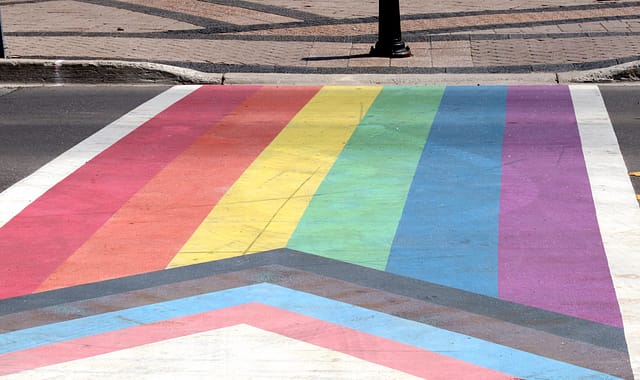
This week, Westlock resident Benita Pedersen is required to defend herself at a lengthy hearing before the Alberta Human Rights Commission’s tribunal. Her supposed wrongdoing arose from a flyer she distributed in 2023 after the Town of Westlock announced plans to paint a “rainbow” crosswalk to promote “Pride.” Ms. Pedersen encouraged residents to contact their elected representatives and oppose the project.
Ms. Pedersen has explained that her concern grew from her experiences working with parents and children. She believes that “gender affirmation” harms children more than it helps them, and she wanted to warn parents about what can follow when children begin down the path of transgenderism. Laurie Hodge, another Westlock resident (who also happened to be a political opponent during the municipal elections) disagreed. Ms. Hodge filed a human rights complaint alleging discrimination based on gender, gender identity, and gender expression.
Whatever one thinks about “rainbow” crosswalks, transgenderism, or Ms. Pedersen’s choice of words, her flyer addressed public policy and the use of public property. These are legitimate subjects for democratic debate. Citizens must remain free to support, criticize, or reject the messages promoted by their governments. Treating one side of that debate as a human rights offence converts disagreement into legal jeopardy.
It would be easy to blame the complaint that began these proceedings, but the real problem is that Section 3 of the Alberta Human Rights Act gives the state a way to punish free expression in the first place.
Sections 4 through 10 of the Alberta Human Rights Act outlaw discrimination in services, accommodation, tenancy, employment, job advertising, and related areas of civic life. These provisions address conduct: refusing someone a job, a home, or a service because of their race, religion, age, sexual proclivities, or other personal characteristics. These sections also prohibit, implicitly but strongly, all discriminatory notices tied to those activities, like a sign that might say people of a certain race aren’t welcome to walk in to a store.
Section 3 is different. It outlaws all “statements” and “publications” that indicate discrimination or an intention to discriminate. This includes what an Albertan says on social media or the internet. Although Section 3 also says that it must not be interpreted as interfering with the free expression of opinion, decades of human rights proceedings and court rulings have shown how little comfort that assurance provides. Section 3 of the Alberta Human Rights Act has become the legal doorway through which citizens are investigated and prosecuted for participating in public debates about moral, cultural, and political issues.
Ms. Pedersen is not alone. Leduc business owner and former municipal candidate Karen Richert faces a human rights complaint arising from comments she made about a “family-friendly” drag show promoted by a local dance studio. Ms. Richert suggested that children should not be exposed to such performances. Even if she ultimately prevails against the human rights complaint that was filed against her, she will have spent time, money, and energy defending speech that should never have triggered a prosecution.
Alberta has seen this before. In 2002, the Red Deer Advocate published a letter to the editor by youth pastor Stephen Boissoin about LGBTQ issues. An activist University of Calgary professor filed a human rights complaint. In 2008, an Alberta human rights panel ordered Mr. Boissoin to pay $5,000 to the complainant professor, and imposed sweeping restrictions on his future speech. The courts eventually set the ruling aside, culminating in an Alberta Court of Appeal ruling in 2012—more than a decade after the newspaper published his letter.
Mr. Boissoin won, but only after 10 years of stress and expensive legal proceedings. His case illustrates a truth that is too often ignored: the process itself is punishment. The government finances the system that advances the complaint. The citizen must finance a defence. Even a “successful” respondent like Stephen Boissoin cannot recover the full personal, professional, and financial losses caused by years under prosecution.
Criminal law sets a deliberately high threshold for illegal expression. A prosecution for wilfully promoting hatred requires proof beyond a reasonable doubt, and the Criminal Code recognizes specific defences, including truth. Human rights proceedings operate differently. Their relaxed procedures and lower thresholds can expose citizens to years of litigation over expression that is controversial, upsetting, or alleged to have a discriminatory effect, even when it forms part of a sincere political or moral argument.
That imbalance chills far more speech than the words named in any single complaint. Every prolonged prosecution sends a warning to other Albertans: speak candidly about gender, sexuality, religion, or the welfare of children and you may be forced to spend years defending yourself before a tribunal. An offended party can file a human rights complaint against you.
Repealing Section 3 of the Alberta Human Rights Act would not legalize discrimination. The act would continue to prohibit discrimination in employment, tenancy, services, accommodation, and other important areas. An employer could not legally post a sign saying that he would refuse to hire someone because of race or sex. A landlord could not deny housing on a prohibited ground, or advertise its discriminatory intent. A business could not exclude customers because of their religion, or post a sign saying it would do so.
What would change is that Albertans could once again debate public questions without facing a human rights prosecution merely because their opinions are unpopular or deeply offensive to someone else. Freedom of speech is a basic human right, protected by Section 2(b) of the Canadian Charter of Rights and Freedoms and essential to democratic self-government.
Premier Danielle Smith and her government often speak in favour of free expression. The legislature returns on Oct. 27. Repealing Section 3 this fall would turn those words into action. It would end an injustice that has remained on Alberta’s statute books through successive governments for decades, and would ensure that future disputes over public policy are answered with more speech, not taxpayer-funded prosecutions.
Benita Pedersen and Karen Richert should not have to live under the threat of punishment for expressing their views. Neither should any other Albertan. Alberta can protect people from actual discrimination without empowering a tribunal to police political, moral, and cultural opinions. The legislature should repeal Section 3 of the Alberta Human Rights Act.
John Carpay, BA, LLB, is President of the Justice Centre for Constitutional Freedoms.
Epoch Times: Alberta must amend its Human Rights Act to protect free speech
Published:
Media inquiries: media@jccf.ca
~6 min read aloud

Media inquiries: media@jccf.ca
Benita Pedersen human rights matter
The #BenitaPedersen human rights tribunal hearing has begun -- with a land acknowledgement. We will post updates here throughout the hearing as evidence and arguments unfold. pic.twitter.com/iAAyqi6LNz
— Justice Centre for Constitutional Freedoms (@JCCFCanada) September 14, 2026
Constitutional lawyer Allison Pejovic
🚨 BREAKING: Constitutional lawyer Allison Pejovic provides an exclusive update on Benita Pedersen’s September 14 human rights hearing. Ms. Pedersen faces a complaint after distributing a flyer opposing a proposed "Pride" crosswalk in Westlock, Alberta.
— Justice Centre for Constitutional Freedoms (@JCCFCanada) September 11, 2026
Thanks to the generosity… pic.twitter.com/w0hGxrXZRX