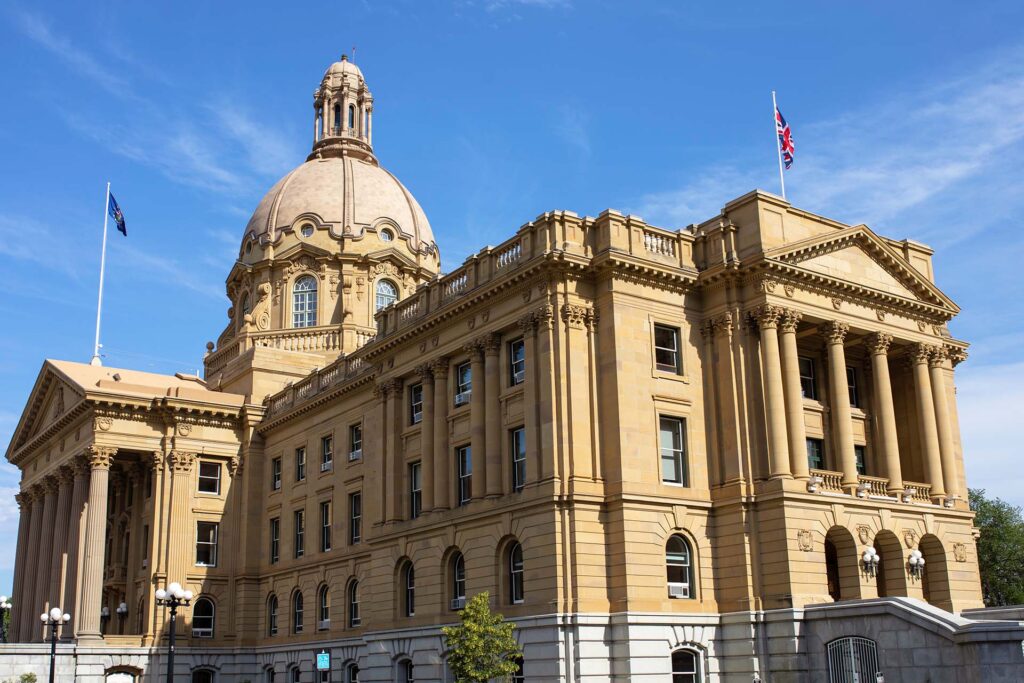
By introducing Bill 9, the Alberta government is wisely and necessarily using a legitimate section of the Charter of Rights and Freedoms to opt out of a radical and revolutionary court ruling issued this past June by the Alberta Court of King’s Bench.
At issue is Alberta’s Bill 26, which prevents ideological doctors from prescribing puberty blockers and opposite-sex hormones to minors under 16. An LGBT etc. advocacy group along with other activists are challenging Bill 26 in court, arguing that minors have a constitutional right to these treatments and that government should not “impose” choices on youth.
Such groups apparently don’t object to laws that prohibit minors from voting, driving, smoking cigarettes, consuming alcohol, having sex with an adult, and joining the military. But when it comes to taking puberty blockers and opposite-sex hormones, and taking other steps on a journey towards life-altering surgeries that remove healthy body parts, they think that minors actually have a Charter right to make irreversible medical decisions.
In their 123-page court brief, the applicants assert with strident confidence that minors are constitutionally entitled to access puberty blockers and opposite-sex hormones, and that these treatments are both beneficial and medically necessary. The brief suggested that gender-confused teens will kill themselves if they go through normal puberty, but provides no hard data to support this claim. The brief described breast removal as “chest masculinization” surgery.
On June 27, the Alberta Court of King’s Bench suspended the province’s law to protect vulnerable minors from the harms of puberty blockers, opposite-sex hormones, and life-altering surgeries. By granting the applicants the temporary injunction that they sought, the court effectively put Bill 26 on hold for years. The temporary injunction is in force until after the trial occurs and the court issues its permanent ruling (which may be appealed to a higher court).
It would take literally years for the Alberta Court of King’s Bench to receive, review, and consider the massive volume of competing evidence and arguments that would be submitted by the two sides. As a concrete example of how long court actions take, when Rebecca Ingram and other Albertans commenced a court challenge in December 2020 to defend their human rights and Charter-protected freedoms from unscientific lockdowns, they did not obtain a court ruling until July of 2023, more than 2.5 years later.
Further, many judges these days are ideologically driven. They seek to advance, for instance, equity, diversity, and inclusion rather than the rule of law. The chance of a judge agreeing with the Alberta government about protecting children and teens from transgender ideology is small.
Alberta’s Bill 26 aligns with policies that have been adopted in the United Kingdom, Sweden, Norway, Finland, Denmark, Italy, and other countries. Alberta’s 183-page brief summarized hundreds of pages of evidence and findings from numerous countries, with particular emphasis on the independent Cass Review conducted in the United Kingdom by Dr. Hillary Cass.
According to the Cass Review, the rationale for early puberty suppression remains unclear; these drugs are not the best way to manage gender-related distress experienced by young people. Apart from physical impacts on the body, the effect of puberty blockers on cognitive and psychosexual development remains unknown. Opposite-sex hormones have been used for many years in the adult transgender population, but there is no reliable information about their long-term impact on minors. Around the world, a growing body of evidence points to harms—and an absence of benefits—resulting from giving puberty blockers and opposite-sex hormones to children and teens. Many countries are no longer giving puberty blockers and opposite-sex hormones to minors.
In defending Bill 26 in court, Alberta argued that giving puberty blockers and opposite-sex hormones to teenagers is not supported by strong scientific consensus.
The court’s June 2025 ruling provided little explanation as to why it preferred the evidence of the applicants over the evidence of Alberta.
Of interest, the judge in her ruling adopted the biased ideological language used by the applicants, asserting that gender is somehow “assigned” at birth, as opposed to being obvious biological reality. She described giving estrogen to boys and giving testosterone to girls as “gender-affirming” hormone treatment. She declared that “gender identity is an immutable characteristic,” in spite of abundant evidence showing that many people experience changes in their feelings and identities over time.
The judge asserted that going through normal puberty constitutes “irreparable harm” for gender-confused children. She expressed full confidence in doctors who prescribe puberty blockers and opposite-sex hormones to children, trusting these ideologues to “do so with a careful eye to the needs of the patient and the risks of the treatment.” She gave scant attention to the irreparable harm done to vulnerable children and teenagers who later regret having been encouraged to embark on the futile quest to become a member of the opposite sex.
The Alberta government is facing an ideological court ruling, an injunction that will remain in force for two or more years, and (in all likelihood) a permanent court judgment striking down legislation that would have protected vulnerable minors from serious harm.
Hence, Bill 9. If the Alberta government wishes to move ahead with sensible laws to protect children from transgender ideology, the only way to do it is by using Section 33 of the Charter (the notwithstanding clause) to opt out of the June 2025 court ruling. This is precisely why those who created the Charter and negotiated its contents gave our federal Parliament and our provincial legislatures the power to opt out of bad court rulings.
Without Charter Section 33, Canadians would suffer under judicial tyranny at the hands of unaccountable woke judges, without any recourse or remedy.
John Carpay, B.A., LL.B., is president of the Justice Centre for Constitutional Freedoms (jccf.ca).