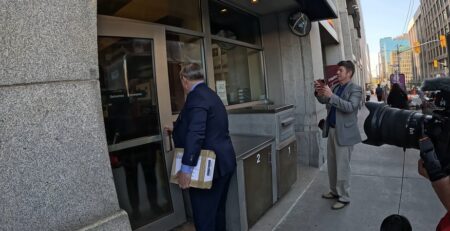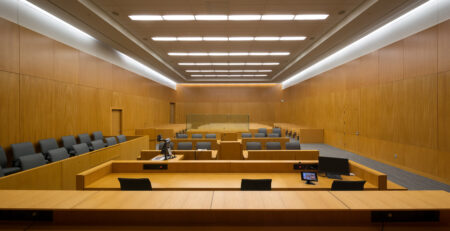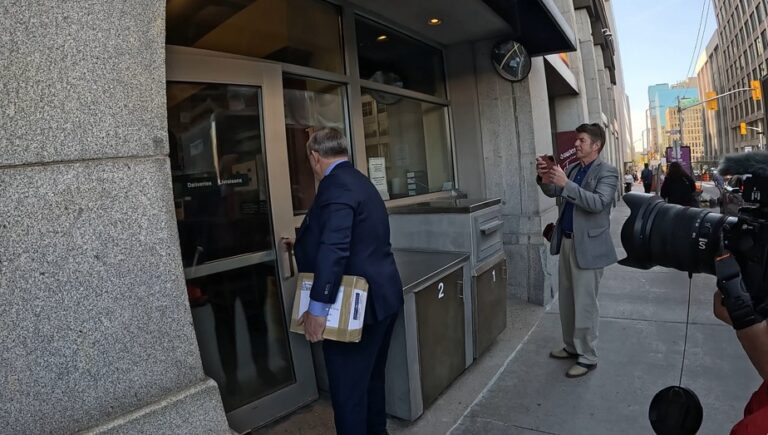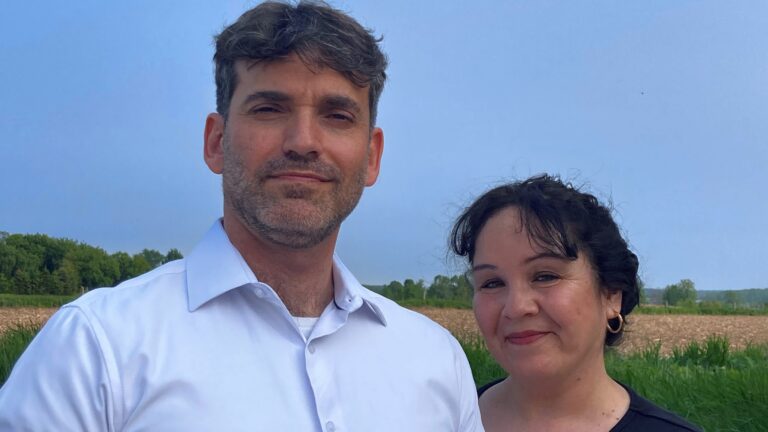
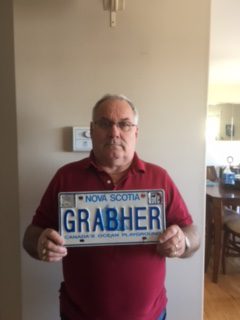
Lorne Grabher, whose personalized ‘GRABHER’ licence plate was deemed “socially unacceptable” by the Nova Scotia Registrar of Motor Vehicles (Registrar), has filed his Affidavit with the Supreme Court of Nova Scotia in preparation for the hearing of Lorne Grabher v. Registrar of Motor Vehicles.
Lorne Grabher first purchased the personalized license plate as a gift for his late father in or around 1990. It became an expression of family pride spanning three generations – Mr. Grabher’s son has the family name on his own personalized license plate in another province. Mr. Grabher testifies in his Affidavit that his son has never had difficulty renewing his plate.
Mr. Grabher notes in his Affidavit that he and his family “are proud of our Austrian-German heritage, and are proud of the immigrant history of our family…We are not ashamed of our immigrant background or our role in Canadian society.” He further notes:
For 27 years the [Registrar] renewed the Plate. My last name has not changed. The Respondent never once informed me when I was renewing my Plate that my last name was objectionable. The idea that my name was appropriate for 27 years, but is suddenly inappropriate today because one anonymous person says so, is ridiculous.
In his Affidavit Mr. Grabher points out that there are numerous government-regulated place names and other expression by government in Canada that is permitted despite being clearly “socially unacceptable”. For example, recent Halifax Water advertisements on public transit buses include “Our minds are in the gutter,” “Be proud of your Dingle,” and “Powerful sh*t”.
“No amount of “misinterpretation” or imagination is required to perceive the sexually suggestive and vulgar nature of the Halifax Water advertisements, yet such expression is not only permitted on Halifax transit buses, it is propagated by the government itself,” explains Mr. Grabher.
Similarly, many government-regulated Canadian places names could be seen as “socially unacceptable” but are supported by governments, including Dildo, Newfoundland and Labrador; Blow Me Down Provincial Park, Newfoundland and Labrador; Crotch Lake, Ontario; Old Squaw Islands, Nunavut; Red Indian Lake, Newfoundland and Labrador; Swastika, Ontario; and Sandy Hook, Manitoba.
“[The] tragic school shooting that took place at Sandy Hook Elementary School in 2012 in the United States has caused the name “Sandy Hook” to become affiliated with gun violence and the death of innocent young children. Yet, the name itself is not inherently offensive, and the place name for Sandy Hook, Manitoba has not been changed,” explains Mr. Grabher.
Background Facts
Mr. Grabher received a letter dated December 9, 2016, from the Office of the Registrar of Motor Vehicles which stated that a complaint had been received regarding his personalized licence plate, and consequently that the Registrar was cancelling it. The reason provided for the cancellation was that the plate could be “misinterpreted” as a “socially unacceptable slogan”.
The Justice Centre wrote to the Registrar on March 31, 2017, calling out the Registrar’s decision as “discriminatory,” “arbitrary,” “unreasonable” and in violation of free expression as guaranteed by the Canadian Charter of Rights and Freedoms. It further advised the Registrar to reinstate the plate or face further legal action. The Registrar refused to voluntarily reinstate Mr. Grabher’s plate, necessitating a court action. The hearing for this case is scheduled for September 8, 2018.