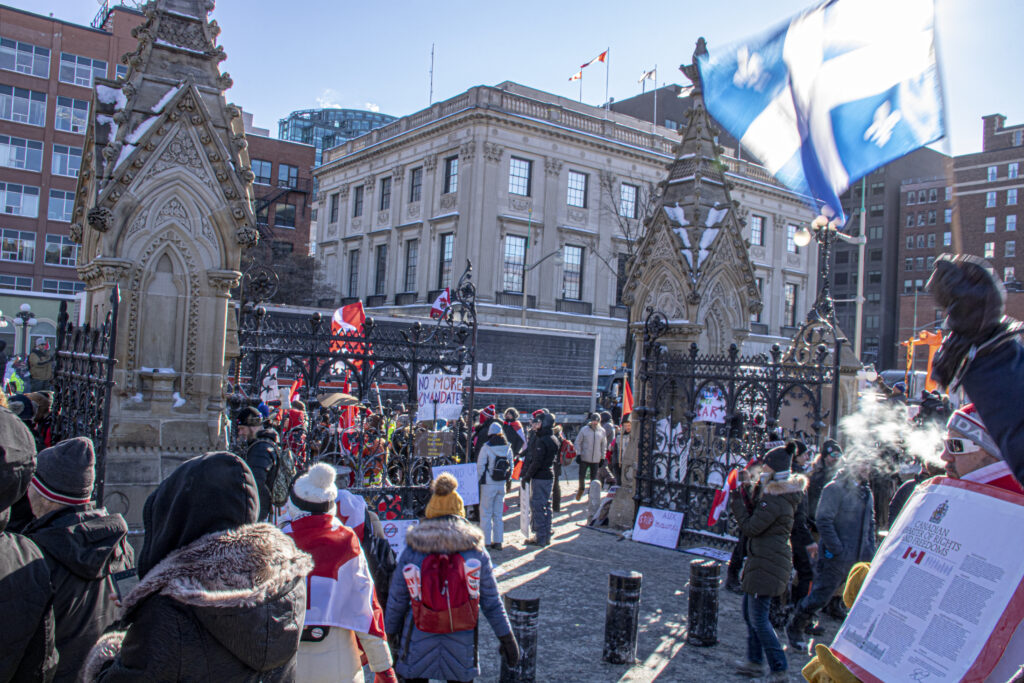

Chief Justice Richard Wagner should recuse himself entirely from the Supreme Court of Canada’s consideration of the federal government’s appeal of lower court rulings, which rebuked its illegal invocation of the Emergencies Act against the peaceful Freedom Convoy.
The Supreme Court has now agreed to hear Ottawa’s appeal, after the federal government lost in both the Federal Court and the Federal Court of Appeal.
In 2024, the Federal Court ruled that the Trudeau cabinet had failed to comply with the Emergencies Act in February 2022. There was no “national emergency” to contend with, and the violation of Charter rights and freedoms was not justified.
Of note, the federal government appealed this lengthy ruling less than an hour after its release, without the Justice Centre having read the judgment. Fortunately, in January 2026, the Federal Court of Appeal upheld that ruling.
Both courts rejected the federal government’s claim that the statutory requirements for a national emergency had been met. The freezing of Canadians’ bank accounts unjustifiably violated Charter rights and freedoms.
Chief Justice Wagner should have no involvement in deciding this appeal because he has already expressed strong public opposition to Freedom Convoy.
In 2022, Wagner described the protest in downtown Ottawa as involving “hostage-taking” and the beginning of “anarchy.” He attributed the protest to a “certain ignorance” and a “bad understanding” of Canadian law. He also condemned what he called “attacks” on the justice system and democratic institutions and later associated the Freedom Convoy with “disinformation.”
These were extraordinary — and entirely inappropriate — comments for Canada’s Chief Justice to make about events that could reasonably have been expected to produce litigation reaching the Supreme Court.
Judicial impartiality is not limited to whether a judge personally believes he can decide a case fairly. Justice must also be seen to be done. Canadians should not be asked to trust that a judge who publicly denounced one side of a major national controversy can later approach that same controversy with the appearance of complete neutrality.
This concern is especially serious because the federal government’s case continues to rely on a distorted account of what actually happened in February 2022.
In its written argument to the Supreme Court, Ottawa claims that the Freedom Convoy had occupied downtown Ottawa for weeks “with no end in sight.”
That assertion ignores important evidence.
Before the Trudeau cabinet invoked the Emergencies Act, protest organizers had already reached an agreement with the City of Ottawa to move trucks out of the downtown residential area.
Serge Arpin, chief of staff to the mayor of Ottawa, later testified under oath that 102 trucks had moved by noon on February 14, 2022. Most left Ottawa altogether, while some relocated toward Wellington Street as contemplated by the agreement.
Ottawa’s General Manager of Emergency and Protective Services, Kim Ayotte, also testified that the movement of vehicles onto Wellington Street was stopped by police.
The federal government disingenuously presents the convoy as an indefinite occupation with “no end in sight” when, in fact, the peaceful protesters were already moving vehicles out of Ottawa’s central core to implement an agreement with the city.
Ottawa also relies heavily on border blockades at Coutts, Alberta, and Windsor, Ontario, to suggest that Canada was facing a continuing nationwide emergency requiring extraordinary federal powers. But these blockades had been fully resolved and cleared prior to Trudeau invoking the Emergencies Act.
Neither the Coutts nor the Windsor event established that extraordinary emergency powers were necessary to deal with peaceful protesters in Ottawa.
The government’s Supreme Court materials further claim that “swastikas” were “held or worn by some protesters,” repeating one of the most persistent smears directed at the Freedom Convoy.
What Canadians actually saw was one unidentified person, with his face covered, carrying a Nazi flag, who disappeared from sight after the photo was taken. There has never been evidence establishing that this individual was a Freedom Convoy participant or supporter. Yet this single photo was repeatedly used to discredit thousands of peaceful Canadians.
Justin Trudeau had set the tone before the protesters even arrived in Ottawa when he dismissed them as a “fringe minority” with “unacceptable views.” Canada’s government-funded media subsequently adopted and amplified that narrative.
The federal government is now asking the Supreme Court to overturn two court decisions finding that the cabinet did not satisfy the legal requirements for invoking the Emergencies Act. This appeal should be determined according to the statute, the evidence and the Charter, not according to whether judges approved or disapproved of the protesters.
Chief Justice Wagner has already told Canadians what he thought of the Freedom Convoy. He called the protest an example of hostage-taking and anarchy and attributed it to ignorance and misunderstanding of Canadian law. Those comments create an obvious appearance of bias in a case arising directly from the same events.
Recusal would not determine the outcome of the appeal, nor would it prevent the remaining judges of the Supreme Court from deciding whatever legal issues are properly before them. It would simply demonstrate respect for the fundamental principle that courts must not only be impartial but must appear impartial.
For the sake of public confidence in the Supreme Court of Canada, Chief Justice Richard Wagner should take no part in this case.
John Carpay, BA, LLB, is President of the Justice Centre for Constitutional Freedoms.
Read this column in the Juno News