Some Canadians seem to think that sovereignty matters only when dealing with the United States.
“Elbows up!” they say, when Donald Trump threatens to annex Canada. But many of these same Canadian nationalists showed little concern when the federal government accepted the World Health Organization’s International Health Regulations, which authorize the WHO to direct an international response to a future “Public Health Emergency” as defined by the WHO itself.
For fair-weather sovereigntists, foreign interference is intolerable when it comes from Washington, but considerably less troubling when it comes from Geneva.
Our Constitution establishes democratic accountability: Canadians determine, through their elected representatives, the laws under which we live. The Constitution Act, 1867 assigns exclusive jurisdiction over health care to Canada’s provinces, not the federal government. Nothing in our Constitution grants the WHO authority to determine our health care policies.
Fortunately, the WHO has no army, police force, or courts with which to enforce its wishes. It cannot compel Canada to sacrifice its laws, Constitution, or our Canadian Charter of Rights and Freedoms. Canada’s federal and provincial governments will ultimately choose to comply, or not, with WHO edicts.
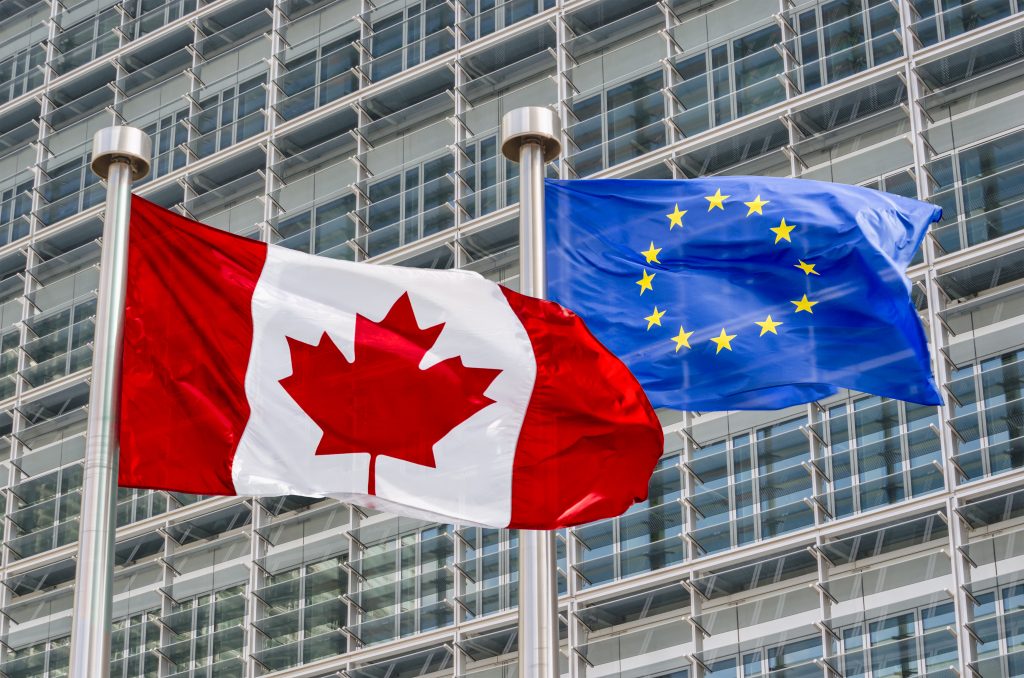
The same question of sovereignty now arises in a different form: the possibility of Canada becoming an “associate member” of the European Union (EU).
Britain’s experience should serve as a warning.
British voters chose to leave the EU in 2016 after 43 years of membership. The Leave campaign captured its central argument in three words: “Take back control.”
The Leave side won in large part because EU membership had transferred significant authority away from Britain’s elected parliament and towards unaccountable European institutions. The European Parliament is directly elected, but has little power. Real power resides in the European Commission, whose commissioners in Brussels are appointed, not elected.
Europeans have only an extremely indirect say in the shaping of the EU laws, regulations, directives and policies under which citizens and taxpayers must live. Gaining access to a market of 450 million consumers that stretches from Portugal to Finland, and from Ireland to Greece, comes with a price attached: member states give up a portion of their sovereignty. EU member states become, in part, like provinces of a larger country, rather than remaining as sovereign nations.
Britain spent decades surrendering powers to the European project and then discovered how difficult it was to get them back. Why would Canada start down a similar road just as Britain has reasserted its sovereignty?
The “associate membership” Prime Minister Mark Carney is discussing with the EU does not yet have a settled legal meaning. That is a source of concern, not comfort.
The sales pitch will undoubtedly be attractive: easier trade, harmonized standards, integrated markets, and fewer regulatory barriers.
But sovereignty is rarely surrendered overnight. It disappears gradually, through apparently modest concessions that accumulate over time. Canadians must not be naïve to this political truth.
Until 1982, the British Parliament retained a formal role in amending Canada’s Constitution. But Britain exercised no practical control over Canadian affairs. Yet that last remaining vestige of colonial rule was considered unacceptable by the Prime Minister of the day, Pierre Trudeau. His government patriated the Constitution so that Canadians would possess full authority over our own constitutional arrangements.
After working so hard to eliminate the last remnant of London’s authority in 1982, why would we want to place Canadian laws and policies under the control of Brussels?
Canadians deserve to know exactly what regulatory alignment, legal obligations or limits on Canadian decision-making would accompany “associate membership.”
The principle is straightforward. If Canadians object to surrendering sovereignty to Washington or London, they should object just as strongly to surrendering it to Geneva or Brussels.
Canadian sovereignty should not depend on which foreigners are asking us to give it up.
John Carpay, BA, LLB, is President of the Justice Centre for Constitutional Freedoms.
Read this column in Juno News