
If the United States demanded that Ottawa consult Washington before Canada adopted “major policy or regulatory initiatives,” Canadians would rightly object. We elect Canadian governments to make Canadian laws.
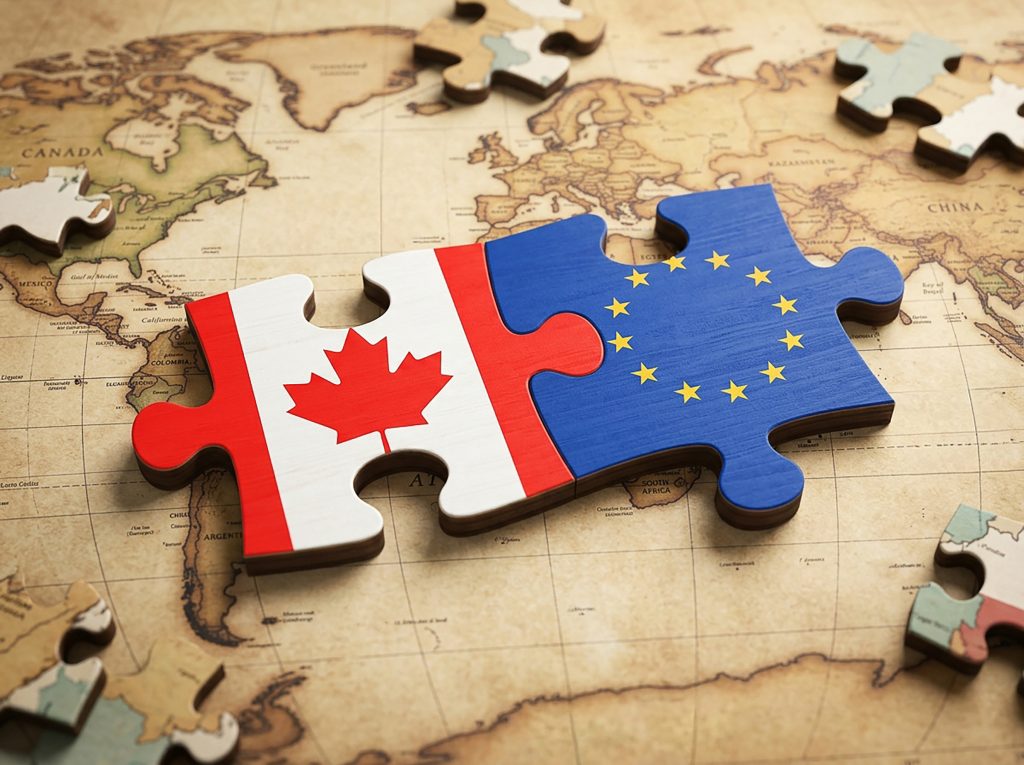
Yet a leaked September draft prepared for this week’s Canada-EU summit in Montreal contemplates a partial surrender of Canadian sovereignty like the one described above. This document proposes regular summits, joint ministerial and cooperation committees, and “mechanisms for early consultation on major policy or regulatory initiatives” so that Canada and the European Union can “align more closely.”
The wording may change before Prime Minister Mark Carney meets European Commission President Ursula von der Leyen and European Council President António Costa on Oct. 29 and 30. I’m told a subsequent revision already exists. But the leak is disturbing because it shows the radical direction in which Ottawa and Brussels want to travel.
The “alliance for the future” reaches far beyond tariffs and ordinary trade. It calls for Canada and the EU to align emerging artificial-intelligence and digital regulatory frameworks, while building on memorandums concerning digital credentials, digital identity wallets, and trust services. It proposes deeper cooperation on pandemic preparedness and health surveillance, a new Canada-EU internal security dialogue, broader judicial cooperation, cybersecurity information-sharing, and closer financial-market integration.
Are the current trade tensions with the United States a valid reason for a complete reimagining of Canada’s place in the world?
Any one of these proposals might be defended on practical grounds. Canada should trade with Europe, cooperate against crime, prepare for pandemics, and pursue sensible technological partnerships. But Canadians should look at the cumulative effect. This is not simply about selling more lumber or buying more European machinery. It is about creating permanent governance structures through which Canadian policy is discussed, coordinated, and increasingly aligned with rules developed on the other side of the world.
“Consultation” is not the same thing as surrendering a veto. Brussels would not, under this draft, acquire the legal power to strike down an Act of Parliament or of a provincial legislature. But sovereignty is rarely lost in one dramatic ceremony. It is more often diluted gradually as governments accept the authority of permanent institutions intended to keep everybody aligned.
Britain provides a warning. When the United Kingdom entered the European Economic Community in 1973, it joined what was sold principally as a common market for free trade. Economic integration demanded common standards, common standards demanded common rules, and common rules demanded institutions capable of making and enforcing them. By the time of the Factortame litigation, British courts refused to apply legislation enacted by Parliament because European law took precedence.
Canada is not Britain, and this proposed alliance is not EU membership. But that should not end the discussion, in which our Parliament should play a key role. Unlike Britain during its years inside the EU, Canada would not elect members of the European Parliament, appoint a European Commissioner, or vote in the European Council. If Canadian regulations are increasingly aligned with European ones, Canadians could end up following rules shaped in Brussels without even the modest political representation Britain once possessed there.
This matters, especially in areas touching directly on civil liberties. Digital identity systems can affect privacy and anonymity. AI regulation can affect freedom of expression and access to information. Health-surveillance arrangements can affect privacy, mobility, and individual autonomy. Internal-security cooperation raises obvious questions about information-sharing and accountability. Canadians should know whether Ottawa intends merely to exchange ideas with Europe or to make Canadian policy increasingly conditional on European regulatory expectations.
Prime Minister Carney presents closer European integration as a way to make Canada more sovereign in an uncertain world. His government says the developing partnership is intended to strengthen Canadian “strategic autonomy, resilience, and sovereignty.” However, the fact is that formal arrangements with the EU will undermine Canadian sovereignty more than any American tariff on Canadian goods.
In the 1970s, Prime Minister Pierre Trudeau sought to diversify trade and reduce excessive dependence on the United States, yet five decades later these goals are still far from being achieved. Cooperating with allies on defence, technology, and economic security are sensible goals, and Canadian sovereignty has not been undermined by the 2017 Canada-European Union Comprehensive Economic and Trade Agreement.
But closer economic ties do not require Canadians to stop asking who ultimately makes our laws.
Canada spent generations acquiring full control over its own constitutional affairs. As recently as 1982, Canadians considered even the last formal residue of British authority over our Constitution unacceptable. It would be a strange achievement to celebrate independence from London and Washington by making our domestic regulatory choices increasingly dependent on Brussels.
Before signing an “alliance for the future,” Ottawa should tell Canadians exactly what “alignment” and “early consultation” will mean in practice.
Will Canadian governments merely inform their European counterparts about proposed policies? Or will Canadian ministers be expected to modify policies in order to maintain regulatory alignment?
Which areas of Canadian law will be covered? Will Canadian provinces have a say?
What commitments will Canada make concerning AI regulation, digital identity, health surveillance, and internal security?
And once these structures are created, how easily can a future government withdraw from them?
Cooperation, friendship, and trade with Europe can and does benefit Canada. But the first duty of a Canadian government is to ensure that Canada creates and maintains its own laws that are under the control of Canadian voters, and only Canadian voters.
John Carpay, BA, LLB, is President of the Justice Centre for Constitutional Freedoms.
Read this column in the Epoch Times