
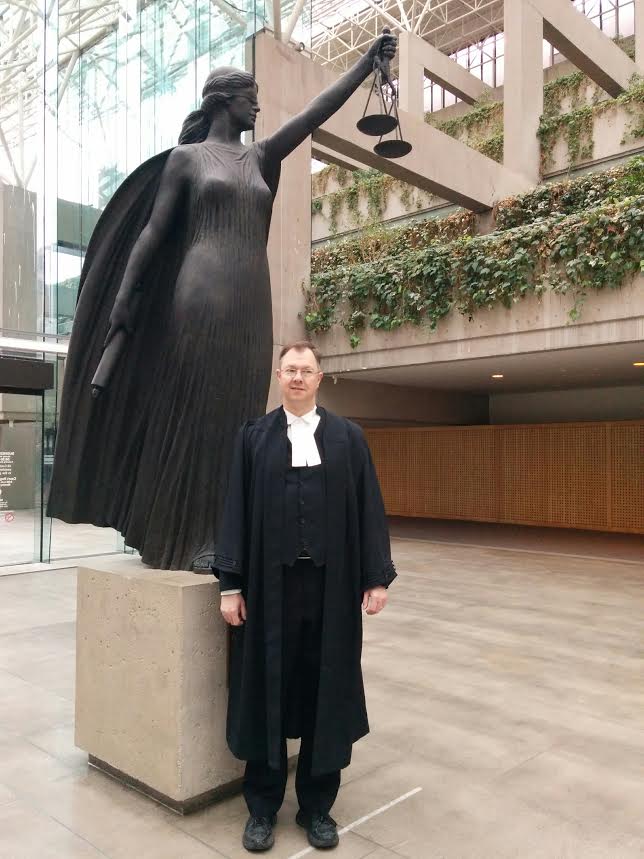
Justice Centre president John Carpay with statue of Lady Justice, the Roman goddess Justitia (the Greek goddess Themis), outside the B.C. Court of Appeal, February 5, 2016.
The B.C. Court of Appeal heard oral argument last week about the rights of university students to express unpopular beliefs on campus, in the case of BC Civil Liberties Association and Cam Cote v. University of Victoria and University of Victoria Students’ Society. The Justice Centre is an intervener in this case, and its filed intervener Factum can be seen here.
This case arose in 2013, when the UVic pro-life student club Youth Protecting Youth (YPY) was granted approval by the University administration to conduct a small, peaceful demonstration on campus, involving students holding pro-life signs, handing out pamphlets, and engaging fellow students in conversation. The day prior to this YPY event, club president Cam Cote received a call from the University administration informing him that approval for the demonstration had been withdrawn, such that YPY could not proceed with expressing its opinions on campus.
As an intervener in the appeal, the Justice Centre argued that the University of Victoria’s decision was unreasonable, and that the University does not have unfettered discretion to censor the peaceful expression of opinion on campus. The Justice Centre argues that UVic is a public body, subject to administrative law principles, including the requirement to give great weight to the free expression rights of all students, and all opinions.
The Justice Centre is deeply indebted to Victoria lawyer Frank Falzon for his pro bono representation of the Justice Centre as an intervener in this case.
With assistance from Justice Centre in-house counsel Marty Moore, Mr. Falzon prepared the Justice Centre’s Factum, and presented oral argument to the BC Court of Appeal on February 4, 2016. In this case, the Justice Centre argued that even if the Charter does not apply to universities, universities as public institutions must nevertheless respect freedom of expression on campus, under the principles of administrative law.