

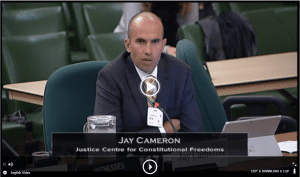
OTTAWA: The Justice Centre for Constitutional Freedoms (JCCF.ca) will appear before the Parliamentary Standing Committee on Justice and Human Rights this Tuesday, April 11, to present its recommendations regarding Bill S-217, An Act to amend the Criminal Code (detention in custody).
The Justice Centre’s Litigation Director, Jay Cameron, will appear before the Standing Committee on Justice and Human Rights between 3:30 P.M. and 5:30 P.M. in Centre Block, Room 237-C.
Other witnesses include Cheryl Webster, Associate Professor, University of Ottawa, Anthony N. Doob, Professor, University of Toronto and Nancy Irving, Barrister and Solicitor.
Bill S-217 (“Wynn’s law”) was tabled before the Senate in February 2016 by Senator Bob Runciman in response to the slaying of RCMP Constable David Wynn by career criminal Shawn Rehn, who was out on bail at the time at the time of the killing on January 17, 2015. This Act amends the Criminal Code so as to require that the criminal record of the accused, if one exists, be put before the judge who is considering the bail hearing.
The Justice Centre will recommend to the Committee that Bill S-217 be enacted, to better ensure the rights and freedoms of Canadians are guaranteed by the judicial process. The Justice Centre’s Brief to Parliament concludes:
The amendment to section 518(1)(c) as proposed in Bill S-217 prevents human prosecutorial error by requiring that the physical paper record of an accused is presented at a bail hearing 100% of the time. The introduction of the accused’s record at a bail hearing is universally in the best interests of the Canadian public and the judiciary. The mandatory introduction of the record is also required to protect the Charter rights of accused persons themselves, both so that they may be aware of the case against them and any errors in the alleged record, as well as so they may have the benefit of the record before an impartial judge.