
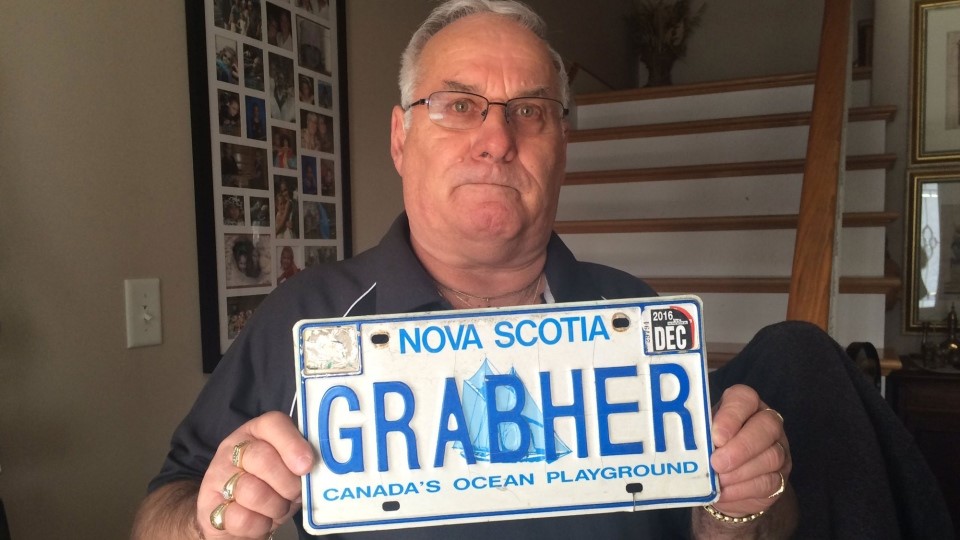
HALIFAX: The Justice Centre for Constitutional Freedoms is disappointed to report that the Nova Scotia Court of Appeal, which released its decision today, found that the Canadian Charter of Rights and Freedoms does not protect the expression of Mr. Grabher’s last name on his personalized license plate.
The Justice Centre filed a court application against the Nova Scotia Registrar of Motor Vehicles (the “Registrar”) after it refused to reinstate the personalized licence plate of Dartmouth, NS pensioner Lorne Grabher, whose surname was deemed too “socially unacceptable” for the road.
Lorne Grabher is a retired senior citizen in his 70s, who was formerly a prison guard. He wore his name on his uniform his entire career without anyone saying it was offensive. He first purchased the personalized license plate as a gift for his late father in 1991. It has since become a source of family pride, spanning three generations – Grabher’s son has the family name on his own personalized Alberta license plate.
In 2016, the Nova Scotia government received a lone complaint from an unidentified individual about the plate. On December 9, 2016, the Nova Scotia Registrar of Motor Vehicles notified Mr. Grabher that his plate had been cancelled. The letter claimed the plate could be “misinterpreted” as a “socially unacceptable slogan.”
After the Registrar failed to reinstate the plate following a demand letter from the Justice Centre, a court application was filed with the Nova Scotia Supreme Court on Mr. Grabher’s behalf. A hearing was held on April 24-25, 2019. Mr. Grabher’s claim was based on freedom of expression and equality rights as protected by the Charter.
In challenging the constitutionality of the pertinent Regulation relied on by Nova Scotia, Mr. Grabher also pointed to a list of “banned” words the province has compiled to illustrate the arbitrary system by which the province regulates personalized plates. The list prohibits the use of many harmless words, such as “FENCE”, “AND”, “SAMPLE”, “NONE”, “SAFE”, and “GOLD”. In her January 31, 2020 ruling, Justice Darlene Jamieson found that the list was largely irrelevant and denied Mr. Grabher the return of his licence plate. She legitimized governments’ use of words like “Dildo”, “Crotch”, “Swastika” and “Sh*t”, and phrases such as “Negro Lake” and “Blow Me Down”, on public property, but ruled that Mr. Grabher cannot use his family name on a licence plate because it might be “offensive”. Justice Jamieson also disagreed with a recent Manitoba Court ruling in finding that “the nature of a [personalized] licence plate is not compatible with free expression.”
The Court of Appeal found that Justice Jamieson did not make any errors that warranted overturning the lower court ruling.
“Freedom of expression is under assault across the nation, and Mr. Grabher’s case is a microcosm of the oppressive and irrational censorship in our society today,” states Jay Cameron, Litigation Director at the Justice Centre and counsel for Lorne Grabher. “Mr. Grabher is disappointed with today’s ruling. We are reviewing the decision.”