
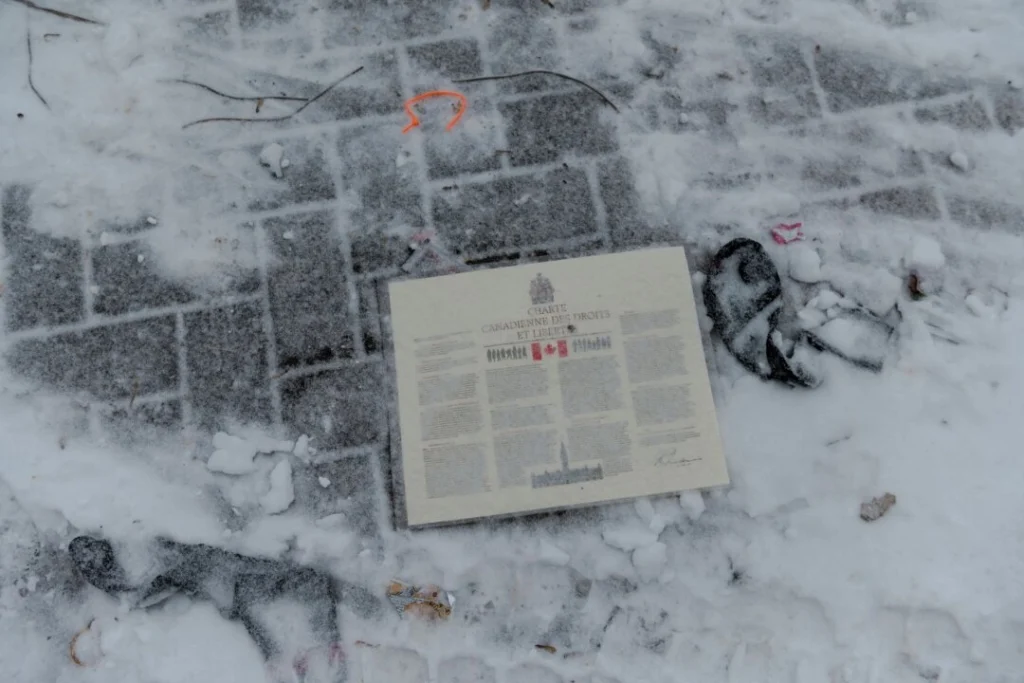
Since lockdowns were imposed in March 2020, governments across Canada have admitted in numerous court challenges that provincial and federal health orders did violate one or more of the Charter freedoms of conscience, religion, expression, peaceful assembly, association, and mobility. In like manner, governments have admitted that vaccine mandates violated the Charter right to bodily autonomy.
Canadian courts have consistently upheld these Charter violations as being reasonable and justified in a free and democratic society—until the Ontario Court of Appeal delivered its judgment in Hillier v. Ontario on April 7.
Randy Hillier, a former Member of Ontario’s Provincial Parliament, challenged Ontario’s total and absolute ban on all outdoor protests, which the government imposed on citizens in April and May of 2021. While up to 10 people could gather for a wedding or funeral, or for a religious service or ceremony, it was illegal for two people to meet outdoors for a peaceful protest!
Mr. Hillier faced charges and fines up to $100,000 for organizing peaceful political protests in Kemptville and Cornwall, and for attending protests in Smiths Falls, Belleville, Peterborough, Stratford, Kitchener, and Chatham throughout April and May 2021. His defence to these charges was that Ontario unjustifiably restricted his Charter freedom of peaceful assembly. In court, Ontario presented no evidence that its total ban on outdoor protests, including those in which Mr. Hillier participated, would reduce the spread of Covid.
Overturning the November 2023 lower court ruling, Court of Appeal Justices Lauwers, Zarnett, and Pomerance ruled unanimously that Ontario’s absolute ban on peaceful assembly in 2021, particularly outdoor political protests, was an unjustified violation of the freedom of peaceful assembly as protected by Section 2(c) of the Charter.
Ontario took religious freedom into account when crafting its restrictions on religious gatherings, but failed to give any thought to permitting a parallel exception for outdoor peaceful assemblies. The court declared that it could not countenance “an outcome in which the state eliminates the free exercise of a fundamental freedom, without giving that elimination any actual thought.” Such outcome would be “entirely contrary to the purpose of the Charter in protecting the free exercise of fundamental freedoms against the limiting actions of government.”
While stating that “the pandemic posed significant challenges for Ontario,” the court declared that “the Constitution does not fade from view in times of crisis.”
For the first time in Canadian judicial history, an appellate court has outlined the nature, purpose, and benefits of the Charter section 2(c) freedom of peaceful assembly, declaring it “elemental” and “integral to a functioning democracy.” Previously, peaceful assembly has been ignored and subsumed into the other Charter section 2 freedoms of expression, association, religion, and conscience. Now a court has ruled that freedom of peaceful assembly should no longer be treated as the “forgotten sibling of the other fundamental freedoms.”
Peaceful assembly differs from the other fundamental freedoms because “a demonstration is an act of solidarity, a coming together of similarly minded individuals,” who can “make visible the extent and depth of support for a position,” the ruling said.
The freedom of peaceful assembly protects the ability of citizens to get the community to pay attention to their message of protest or dissent, and entice others to become involved in redressing grievances. The court noted that “outdoor protests are especially effective at amplifying minority voices and expressing political dissent.” Ontario’s total ban on peaceful protests denied citizens of their “opportunity to influence public policy by this time-honoured method.”
Significantly, the court ruled that social media and virtual gatherings are not adequate substitutes for in-person gatherings: “digital connectivity” cannot replace the “traditional means of participating in public assemblies.” A public gathering brings individuals together, giving them a sense of presence and connection with others that no technology can match.
Governments across Canada have been put on notice that they cannot ban peaceful political gatherings. Freedom-loving Canadians can be encouraged that the Ontario Court of Appeal has elevated a previously “forgotten freedom” to overturn a Covid-era ban on the exercise of that same Charter freedom. Could protection of Charter freedoms in Canada be making a comeback?
John Carpay – The Epoch Times