
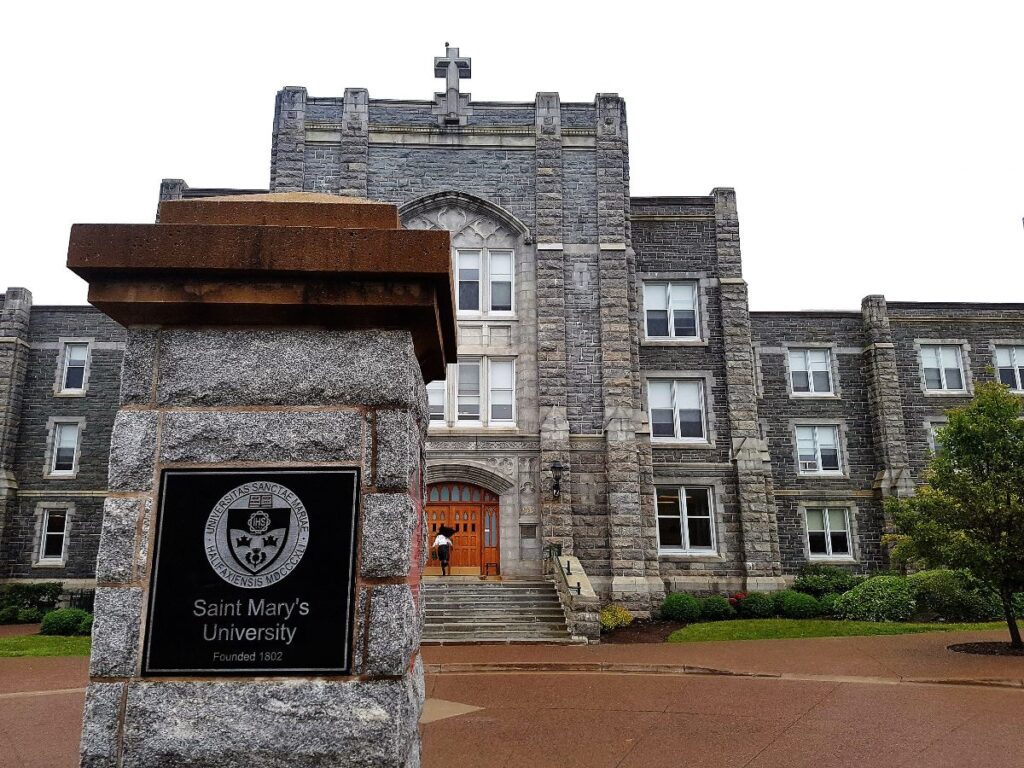
HALIFAX, NS: The Justice Centre for Constitutional Freedoms is providing lawyers to the Society for Academic Freedom and Scholarship in a case that puts pressure on procedural fairness, freedom of expression, and the legal threshold for discrimination.
In a 2019 article posted to the website of the Society for Academic Freedom and Scholarship (Society), Professor John MacKinnon recounted his experience with a student to whom he referred as “Q” – an indigenous student taking one of his classes at St. Mary’s University (University) in Halifax. In the final days of the Winter 2018 term, Professor MacKinnon learned, to his surprise, that Q had been allowed to withdraw from a course she was failing ten days past the withdrawal deadline. Normally, accommodations like this are granted only in extreme circumstances, such as medical issues or a death in the family.
In the article, Professor MacKinnon questioned “[h]ow many academic regulations have been relaxed or ignored, how many transcripts tampered with, how many grades inflated and pseudo-subjects concocted in deference to the imperatives of ‘indigenization’?” – a concerning process occurring within and beyond the classroom on academic campuses, according to Professor MacKinnon.
Later that year, the student realized that “Q” referred to herself and brought the article to the attention of Professor MacKinnon and the University. In her complaint, she reported feeling demeaned, mocked, and labeled by the article.
Professor Mackinnon and the student agreed to mediation under a University Conflict Resolution Advisor. As a result, Professor MacKinnon apologized to the student. The article was removed from the SAFS website.
Thirteen months after she had become aware of the article, she filed a discrimination complaint against the University and the Society to the Nova Scotia Human Rights Commission (NSHRC).
Because the deadline for filing the complaint had passed, the NSHRC encouraged the student to apply for an extension, which she did. The NSHRC accepted the complaint but failed to notify the University or the Society. In fact, it was not until June 4, 2021, that they received a copy of the original complaint.
The NSHRC conducted an initial investigation.
On June 6, 2024, the NSHRC referred the complaint to the Board of Inquiry for a formal hearing to determine whether discrimination had taken place under Nova Scotia’s Human Rights Act. To be referred to a Board of Inquiry, the Commission must be satisfied that the facts, if proven, could establish a case of discrimination.
On July 30, 2024, the University asked the Supreme Court of Nova Scotia to review the NSHRC’s decision to escalate the case by referring it to the Board of Inquiry. And, in January and February 2025, lawyers for the University and Society argued in court before Justice Denise Boudreau that the complaint should never have been referred to the Board of Inquiry.
In addition to pointing out procedural unfairness due to unreasonable delays, the Society argued that there is no evidence of discrimination and that human rights laws do not exist to prevent hurt feelings, humiliation, or offensiveness.
On the contrary, discrimination laws are meant to address only “the most extreme type of expression that has the potential to incite or inspire discriminatory treatment against protected groups on the basis of a prohibited ground.” And, the original article, the Society argued, poses questions on issues of public importance: the integrity of academic institutions. To decide that such inquiry is discriminatory would be a violation of freedom of expression – protected by section 2(b) of the Canadian Charter of Rights and Freedoms.
Indeed, as constitutional lawyer Chris Fleury noted, “This case raises an important issue of whether discrimination can be established under provincial human right’s legislation in the context of the publication of text which had no material impact on the complainant. The Society for Academic Freedom and Scholarship relies on caselaw from the Supreme Court of Canada which has repeatedly held that human rights statutes do not exist to prevent ‘hurt feelings, humiliation or offensiveness’ but rather to the address ‘the most extreme type of expression that has the potential to incite or inspire discriminatory treatment against protected groups on the basis of a prohibited ground.'”
“To permit meritless complaints to proceed to a Board of Inquiry would create a chilling effect on the free expression of the Society for Academic Freedom and Scholarship and others,” Mr. Fleury concluded.
We are awaiting a decision from the Supreme Court of Nova Scotia.