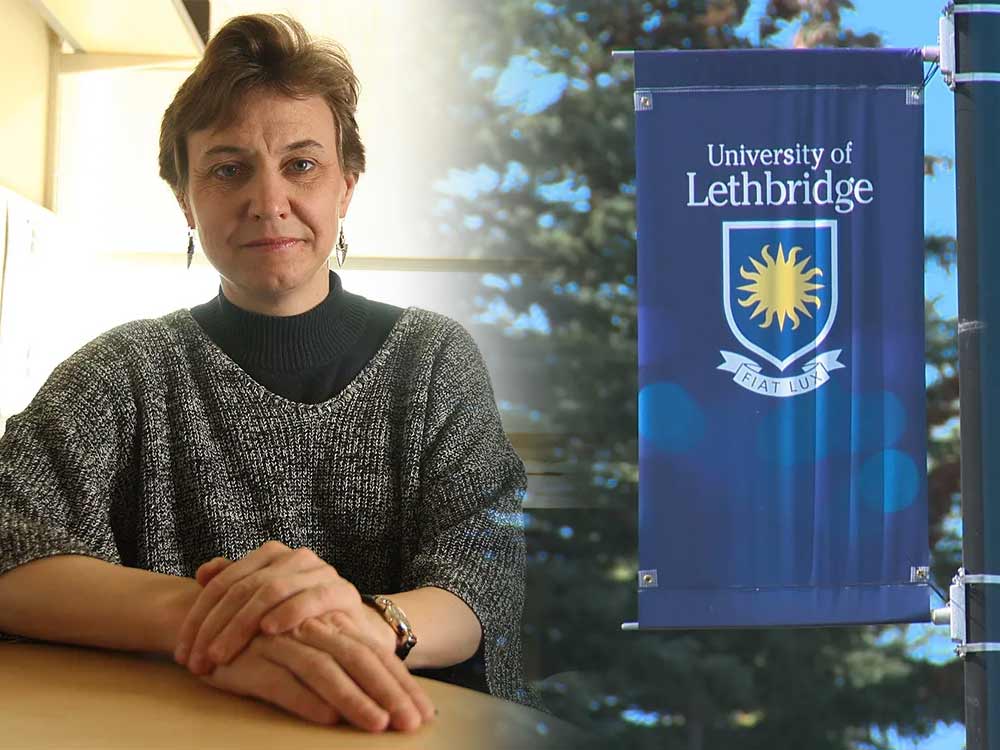
Dr. Frances Widdowson was a tenured professor at Mount Royal University until her position was terminated in late 2021. Her research focused on public policy concerning indigenous people, including the causes of socioeconomic disparities between indigenous and other Canadians. She also criticized the impact of identity politics on academic freedom and open inquiry.
University cancelled Dr. Widdowson’s campus lecture
In November 2022, University of Lethbridge philosophy professor Dr. Paul Viminitz invited Dr. Widdowson to deliver a lecture titled “How Woke-ism Threatens Academic Freedom.” The university approved the event for February 1, 2023.
After some faculty members, students, alumni, and members of the public demanded that the event be cancelled, university president Mike Mahon reversed course and cancelled it. He cited concerns about potential harm to members of the campus community.
Despite the cancellation, Dr. Widdowson attempted to deliver her lecture in the university atrium. A large counter-protest drowned her out with shouting, chanting, and drumming. The talk was eventually moved online.
A constitutional challenge was filed
With help from the Justice Centre, Dr. Widdowson and University of Lethbridge student Jonah Pickle filed a constitutional challenge against the university on July 26, 2023. They argued that the cancellation violated their freedoms of expression and peaceful assembly under the Canadian Charter of Rights and Freedoms.
Mr. Pickle had intended to attend the lecture. The challenge therefore addressed not only Dr. Widdowson’s right to speak but also the right of audience members to hear her.
Court quashed the university’s cancellation decision
In September 2026, the Alberta Court of King’s Bench quashed the University of Lethbridge’s decision to cancel Dr. Widdowson’s lecture. The Court found that the university erred in law by failing to consider Charter-protected freedom of expression. It called the decision “fundamentally and fatally flawed.”
Justice C.D. Simard rejected the university’s attempt to characterize the cancellation as merely a room-booking decision. The Court found that the university was “knowingly involved in regulating students’ freedom of expression on campus” and that this was a “governmental act subject to the Charter.”
The judgment also affirmed that freedom of expression protects audiences as well as speakers. Justice Simard found that Mr. Pickle’s section 2(b) rights included “the right to be able to attend and listen to what was said at the Event.”
The university had adopted a free-expression policy committing itself to “free and open critical inquiry” and guaranteeing “the broadest possible latitude to speak, write, listen, challenge and learn.” The policy also stated that disagreement or discomfort did not justify shielding students from ideas or opinions.
Nevertheless, university officials cancelled the lecture after receiving a large volume of opposition. The university acknowledged that it was limiting freedom of expression but did not expressly consider the Canadian Charter of Rights and Freedoms when reaching its decision.
Justice Simard wrote that “the facts of this case fall squarely” within binding Supreme Court of Canada precedent.
The Court ruled that the university’s failure to recognize and analyze the Charter rights at stake was a “fundamental and fatal” error.
“The university erred in law by not expressly considering and mentioning the Charter in making the Decision,” Justice Simard concluded.
Justice Centre President John Carpay said, “Past Justice Centre court victories have established that the Charter protects freedom of expression on university campuses in Alberta. This decision affirms that principle and the constitutional requirement that universities meaningfully consider freedom of expression when making decisions affecting expressive activities on campus.”
He continued, “This judgment confirms that a public university cannot evade the Charter by pretending that censorship is merely a room-booking decision. Universities exist to promote learning through debate, open inquiry, and the exchange of ideas. They cannot silence a speaker simply because activists demand it or some members of the campus community find her ideas offensive.”
Because the scheduled event date passed more than three years ago, the Court declined to order the university to host the lecture.
The issue of legal costs remains outstanding. The Court gave the parties 45 days to reach an agreement or provide written submissions.
The Justice Centre funded the constitutional challenge brought by Dr. Widdowson and Mr. Pickle.
Lawyers seek records concerning a new campus ban
In a separate matter concerning freedom of expression at the same university, lawyers funded by the Justice Centre applied to the Alberta Court of Justice on Monday, October 19, 2026, for an order requiring the University of Lethbridge to produce unredacted records concerning its indefinite ban on Dr. Widdowson.
The university imposed the ban on February 4, 2026, after Dr. Widdowson attended campus to engage students in a discussion about residential schools. She subsequently faced a trespassing charge arising from her attendance at a university cafeteria on April 25, 2026.
The requested records will support her defence and a planned constitutional challenge to the campus ban. Dr. Widdowson intends to argue that the ban unjustifiably infringed her freedom of expression under section 2(b) of the Canadian Charter of Rights and Freedoms and to seek a stay of the trespassing charge.
The university previously provided records in response to access-to-information requests, but those records contained significant redactions. The application seeks unredacted records relevant to whether the university imposed the ban to restrict Dr. Widdowson’s expression and whether it considered less restrictive alternatives.
The September 2026 judgment concerning the cancelled 2023 lecture did not determine the validity of the February 2026 campus ban. The new proceedings raise further questions about the university’s obligation to respect freedom of expression on campus.
The trespassing matter was scheduled to return to court in Lethbridge on October 27, 2026, at 1:30 p.m. MT.