George Katerberg challenged Ontario’s restriction on political billboards
George Katerberg is a retired HVAC technician and business owner. Following the Covid lockdowns, he closed his business, sold his home, and moved to Thessalon, Ontario, along the shores of Lake Huron.
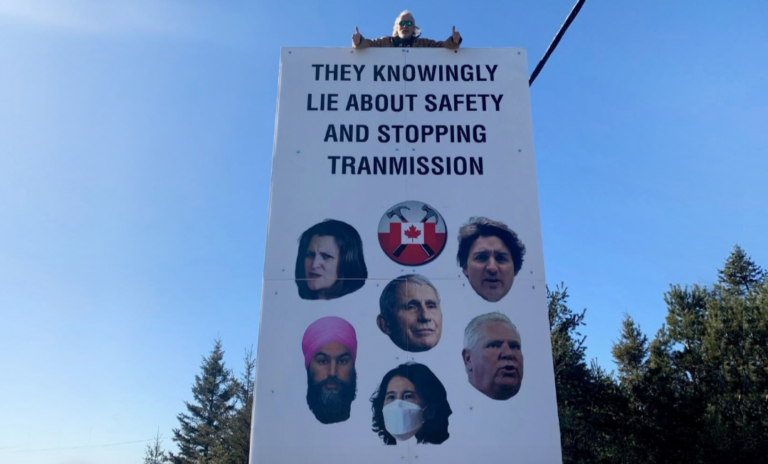
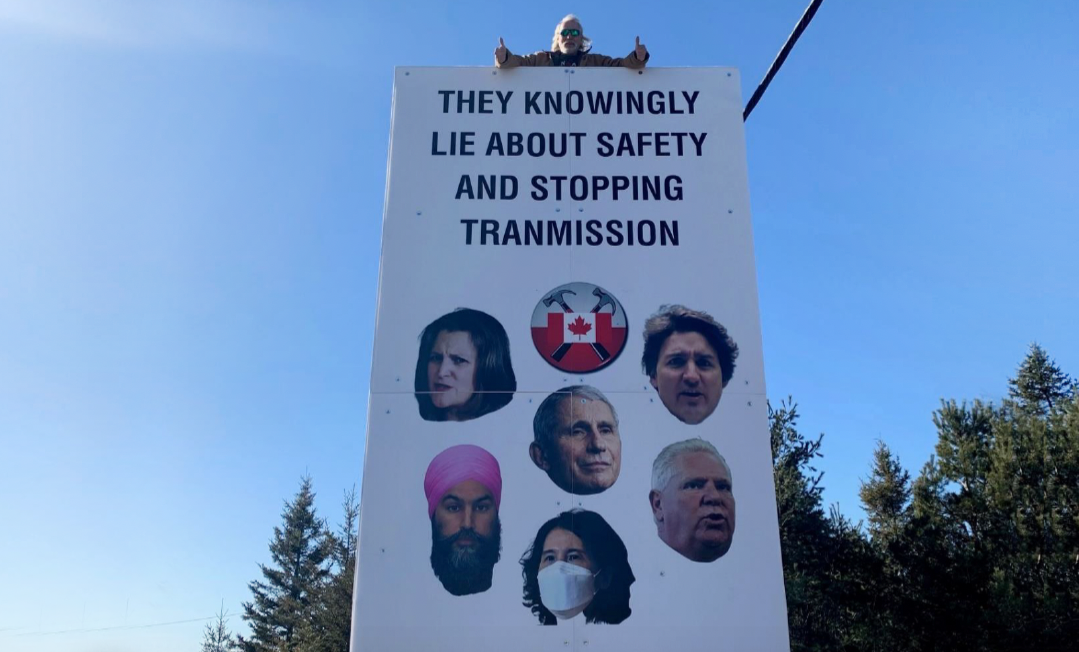
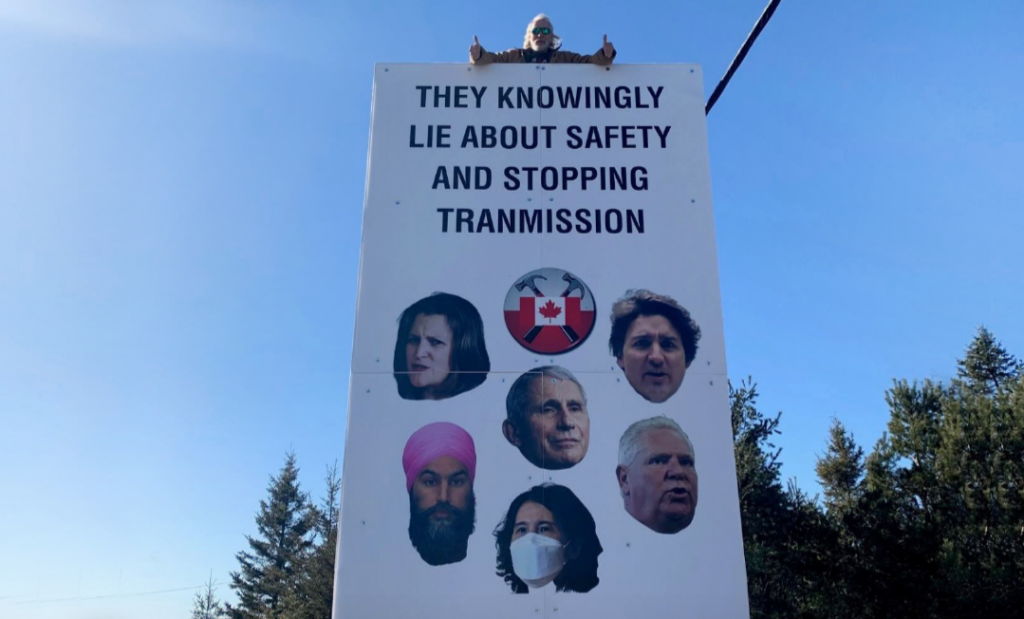
On March 1, 2024, Mr. Katerberg rented a billboard along Highway 17 near Thessalon criticizing the response of government officials to Covid. The billboard displayed the faces of several public officials who had played prominent roles during the pandemic, including former Prime Minister Justin Trudeau, former Deputy Prime Minister Chrystia Freeland, former federal NDP leader Jagmeet Singh, former Ontario Premier Doug Ford, former Chief Public Health Officer of Canada Dr. Theresa Tam, and former Director of the U.S. National Institute of Allergy and Infectious Diseases Dr. Anthony Fauci.
The sign read, “They knowingly lied about safety and stopping tranmission [sic],” and “Canadians demand accountability.” It also featured an image of two hammers behind a Canadian flag. Mr. Katerberg said the design was inspired by a symbol from the 1979 Pink Floyd album, The Wall, which addressed government overreach.
Ontario ordered the billboard removed
Shortly after the billboard was erected, Ontario’s Ministry of Transportation ordered that it be removed after alleging that the hammer image represented white supremacist ideology. Unknown to Mr. Katerberg, the hammer image from The Wall had later been appropriated and used by an American white supremacy music group in the late eighties and early nineties.
Mr. Katerberg immediately removed the billboard and prepared a new sign featuring only the Canadian flag while keeping the same message. He submitted the revised sign to the Ministry for approval.
On June 28, 2024, the Ministry again refused permission, advising Mr. Katerberg that “[t]he message on the billboard may be seen as promoting hatred or contempt for the individuals pictured on the billboard” and requiring that any future billboard be pre-approved by the Ministry.
Constitutional challenge defended freedom of expression
Lawyers funded by the Justice Centre filed a constitutional challenge on Mr. Katerberg’s behalf on July 25, 2024.
The application sought judicial review of the Ministry’s decision, arguing that it was unreasonable because it failed to properly balance Mr. Katerberg’s Charter right to freedom of expression. The application argued that criticizing government officials and calling for accountability are core forms of democratic political expression.
The Notice of Application stated, “The Sign does not promote violence, hatred, or contempt… Further, the Sign does not target any ‘identifiable group’… To the extent that the six well-known public figures featured on the Sign form a group at all, it is on the basis of their collective response to the Covid-19 pandemic in their political and/or professional capacity.”
Lawyer Chris Fleury stated, “Mr. Katerberg’s proposed sign was a matter of legitimate expression protected by the Charter. In a functioning democracy, individuals like Mr. Katerberg need to be able to express their dissatisfaction with public officials. Doing so is not promoting hatred. Mr. Katerberg is looking forward to his day in Court and to eventually being able to erect his billboard.”
Ontario abandoned its original justification
Just six days before the 2025 federal election, the Ministry reversed its earlier position and acknowledged that Mr. Katerberg’s billboard did not promote hatred. It agreed to reconsider its earlier refusal.
For Mr. Katerberg, the case was never about controversy. “I knew there was nothing wrong with my sign,” he said. “I knew if people saw it, they wouldn’t be scared to talk about the mandates.”
Ontario adopted a new policy restricting political billboards
Instead of approving the billboard, the Ministry quietly amended its Highway Corridor Management Manual in April 2025.
The revised policy restricted roadside billboards on certain northern Ontario highways to advertising goods, services, and approved community events. It also broadly prohibited messaging that could allegedly “demean, denigrate, or disparage one or more identifiable persons, groups of persons, firms, organizations, industrial or commercial activities, professions, entities, products or services…”
Relying on the new policy, the Ministry once again refused permission for Mr. Katerberg’s billboard.
Lawyers funded by the Justice Centre filed a second legal challenge, arguing that Ontario could not prohibit political and social expression while continuing to permit commercial advertising.
Constitutional lawyer Chris Fleury explained, “By amending the Highway Corridor Management Manual to effectively prohibit signage that promotes political and social causes, the Ministry of Transportation has turned Mr. Katerberg’s fight to raise his sign into a fight on behalf of all Ontarians who wish to express support for a political or social cause.”
Court ruled Ontario violated Charter rights
Following a hearing before the Ontario Divisional Court, the Court ruled on July 9, 2026, that the Ontario Ministry of Transportation violated Mr. Katerberg’s freedom of expression by refusing permission for his political billboard.
The Court struck down the Ministry’s policy prohibiting political messages on certain northern Ontario highway billboards, declared that it unjustifiably infringed section 2(b) of the Canadian Charter of Rights and Freedoms, set aside the Ministry’s decision, and directed it to reconsider Mr. Katerberg’s application.
The Court emphasized that the case was not about whether Mr. Katerberg’s views were correct, but whether he had the constitutional right to express them. Justice Schreck wrote that “this case is about Mr. Katerberg’s freedom to express his views and not the correctness of those views,” adding that nothing in the decision should be read as endorsing or criticizing those views.
The Court also rejected the Ministry’s argument that political billboards could be prohibited while commercial advertising remained permitted, concluding there was “no rational connection” between the policy and the government’s stated objective. The Court further criticized the Ministry’s handling of Mr. Katerberg’s application, observing that “the manner in which the Ministry dealt with the applicant’s request for permission to put up his sign, which included shifting justifications based on various policies, some of which were not identified, is not to be encouraged.”
Constitutional lawyer Chris Fleury said, “Mr. Katerberg is elated with today’s ruling. The Court was correct to criticize the Ministry’s shifting and inconsistent justifications throughout the process.”
He continued, “The decision is a welcome affirmation of the importance of political expression and that governments cannot prohibit political expression while at the same time permitting commercial advertisement.”
Mr. Katerberg’s case demonstrated that governments cannot silence lawful political criticism simply by changing their reasons for doing so. It also showed that when courageous Canadians stand up for their constitutional freedoms, lawyers funded by the Justice Centre can help ensure that those freedoms are protected for the benefit of all Canadians.