What does Canadian sovereignty mean? It means that we Canadians are fully in charge of running our own country. Canadian sovereignty means that Canadians, not foreigners, pass and repeal and amend our federal, provincial, and municipal laws. Canadian sovereignty is violated when Americans or other foreigners have a say in how we live, or what rules govern our affairs.
But some tend to be “fair-weather” sovereigntists. This refers to those who thump their chests and scream “Never fifty-one!” when President Trump pushes their buttons, but they remained silent when Canada’s federal government accepted the International Health Regulations of the World Health Organization. The International Health Regulations authorize the WHO to direct a worldwide response in a future “Public Health Emergency of International Concern.” In other words: foreigners dictating our health-care policy.
Surrendering Canada’s sovereignty to an international body undermines and offends our Constitution’s principle of democratic accountability, by which Canadians determine, through their elected representatives, the laws under which we shall live. The Constitution Act, 1867 (formerly the British North America Act) assigns exclusive jurisdiction over health care to the provinces, not the federal government. But even if health care were a federal responsibility under our Constitution, the Constitution does not authorize the WHO or other foreign bodies to make or impose regulations or other laws on Canadians.
Fortunately, the WHO has no army, police, or courts to enforce its wishes. Therefore, the organization cannot impose its International Health Regulations on Canada. The WHO cannot force Canada to accept these regulations at the expense of our laws and Constitution, including the Charter of Rights and Freedoms. Unless, that is, our federal and provincial governments voluntarily allow it.
But waving the maple leaf flag in the face of America while endorsing the surrender of our sovereignty to the WHO is not consistent. For example: “I would never allow Americans to violate Canadian sovereignty, but I have no problem with a different set of foreigners doing so.”
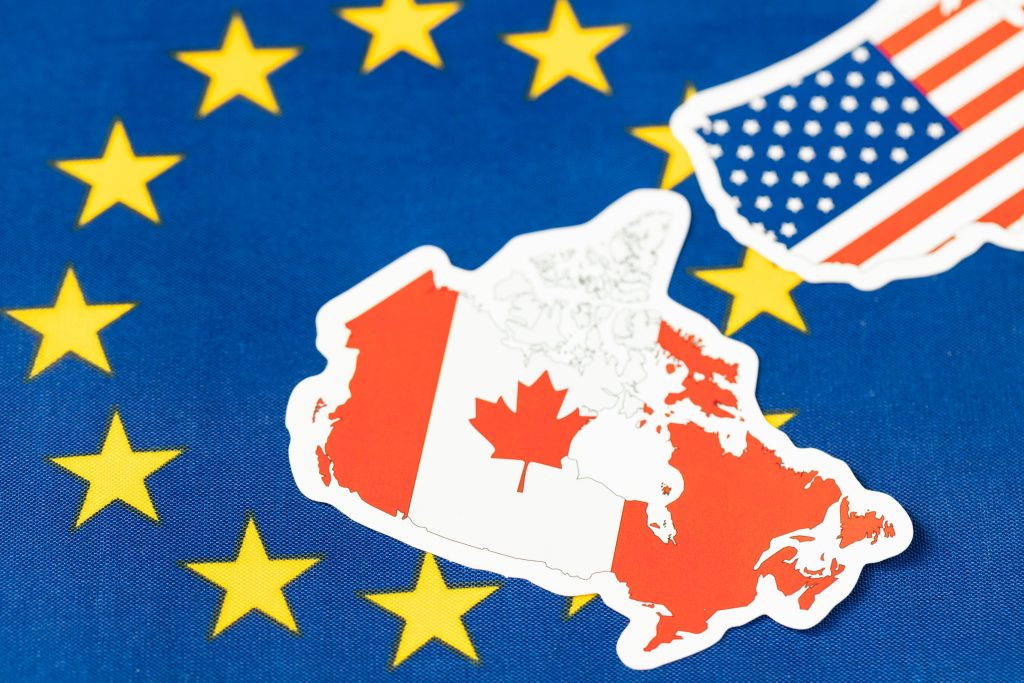
Canadian sovereignty is once again an issue with the possibility of Canada becoming an “associate member” of the European Union.
It’s worth remembering that citizens of the United Kingdom voted to leave the EU in the 2016 Brexit referendum, after 43 years of membership. The desire for national sovereignty, as expressed by the slogan “take back control,” was the driving impetus behind the victory of “Leave” over “Remain.”
The only EU institution over which voters have direct control is the European Parliament, but it exercises little power. Real power lies with the European Commission, whose 27 Commissioners (one for each member state) are appointed, not elected. The EU is only mildly democratic, providing taxpayers with an indirect and extremely limited say in the laws, regulations, and policies that Brussels imposes on people. Bureaucrats in Brussels are insulated from direct accountability. Every EU member state gives up a part of its sovereignty as a condition of belonging to the large free trade zone that stretches from Portugal to Finland, and from Ireland to Greece.
In the 2016 Brexit referendum, the “Leave” campaign pointed to the Factortame litigation as one example of Britain’s loss of sovereignty. The UK Parliament passed the Merchant Shipping Act 1988, partly to stop Spanish-controlled fishing vessels from registering as British and exploiting UK fishing quotas. But this legislation conflicted with European Community law. The result was a constitutional car crash: British courts disapplied provisions of an act passed by the democratically elected Parliament because European law took precedence.
Britain spent nearly half a century discovering how difficult it was to reclaim powers it had gradually surrendered to the European project. Canada would be foolish to begin the same experiment just as Britain has finished escaping it.
The “associate membership,” or “unique alliance” as Prime Minister Carney refers to it, is currently being discussed between Ottawa and the EU, and does not yet have a settled legal meaning, which ought to make Canadians more cautious, not less. The attraction will be economic: easier trade, harmonized standards, integrated markets, and fewer regulatory barriers. Sovereignty is rarely surrendered in one ceremony. It fades like an Indian summer, slowly and hauntingly tempting its onlooker with a majesty that gives way to a brutal, harsh, and long winter of constitutional surrender.
Canada broke away from the tiniest remaining vestiges of British control in 1982, prior to which the United Kingdom’s Parliament had to formalize any changes to Canada’s Constitution. Practically and effectively, Britain had zero control over Canadian affairs in 1982. Yet the thirst for full sovereignty, rather than the 99 percent sovereignty that Canada already enjoyed, proved strong enough to enable then-Prime Minister Pierre Trudeau to push for a new Constitution.
After making so much effort to escape a very small residue of authority held by London in 1982, why would we now seek to place ourselves under the regulation and control of Brussels?
If Mr. Carney can negotiate a free trade deal with the EU, and do so without surrendering any of Canada’s control over Canadian laws and policies, then more power to him. But there ain’t no such thing as a free lunch. In exchange for free access to European markets, the EU will surely demand some measure of control over Canada’s laws, regulations, and policies.
If we are serious about preserving Canadian sovereignty and a meaningful democracy, we should reject foreign power and control consistently, regardless of whether it’s exercised by the UK, the United States, the WHO, or the EU.
John Carpay, BA, LLB, is President of the Justice Centre for Constitutional Freedoms.