SUDBURY, ON: The Justice Centre for Constitutional Freedoms announces that the Ontario Divisional Court will hear a constitutional challenge on Thursday, April 9, 2026 at 10:00 a.m. ET concerning whether the Ontario government can restrict political expression on roadside billboards. The case will determine whether Canadians can be prohibited from displaying political messages on provincially regulated highways, raising significant questions about the scope of freedom of expression protected by the Charter.
Lawyers funded by the Justice Centre, including constitutional lawyers Chris Fleury and Darren Leung, will appear in court on behalf of George Katerberg, a retired tradesman from Thessalon, Ontario.
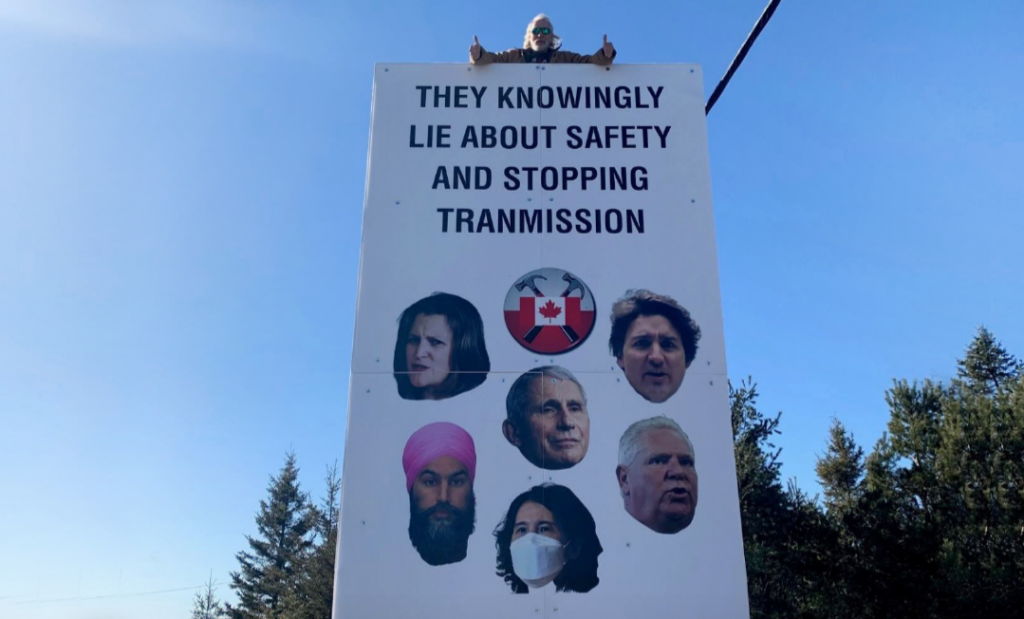
Mr. Katerberg’s case began in 2024 after the Ministry ordered the removal of his billboard along Highway 17 near Thessalon, Ontario. The sign criticized government officials’ handling of Covid and called for accountability from specific public figures, including former Prime Minister Justin Trudeau, former Deputy Prime Minister Chrystia Freeland, Ontario Premier Doug Ford, and former Chief Public Health Officer Theresa Tam. The Ministry initially claimed the billboard promoted hatred, a position it later withdrew.
Despite acknowledging that the billboard did not promote hatred, the Ministry later amended its policies to broadly prohibit political and social messaging on certain highways. Relying on these new guidelines, the Ministry again denied Mr. Katerberg’s proposed sign, prompting this constitutional challenge.
At issue is whether the government can exclude core political speech from a historically public forum.
Constitutional lawyer Chris Fleury said, “Governments should not be permitted to wholly prohibit political and social messaging while allowing commercial and other forms of expression. Ontario’s policy not only prevents Mr. Katerberg from erecting his sign, it also prevents those who disagree with him from expressing their own views on their own signs. It is antithetical to the free exchange of ideas necessary for a functioning democracy.”
Darren Leung said, “The Ministry of Transportation first claimed this billboard was hateful, then admitted it was not, and now seeks to ban it anyway under a sweeping new policy. That kind of moving goalpost undermines the Charter and allows governments to silence lawful dissent simply because it is inconvenient or unpopular.”
The Ontario government, in its court filings, maintains that freedom of expression does not extend to political messages displayed on certain provincially regulated highways and that such spaces may be restricted to commercial or approved community advertising.
A decision in this case could have wide-ranging implications for political expression across Ontario and Canada, particularly where governments seek to limit where and how citizens may communicate their views.